
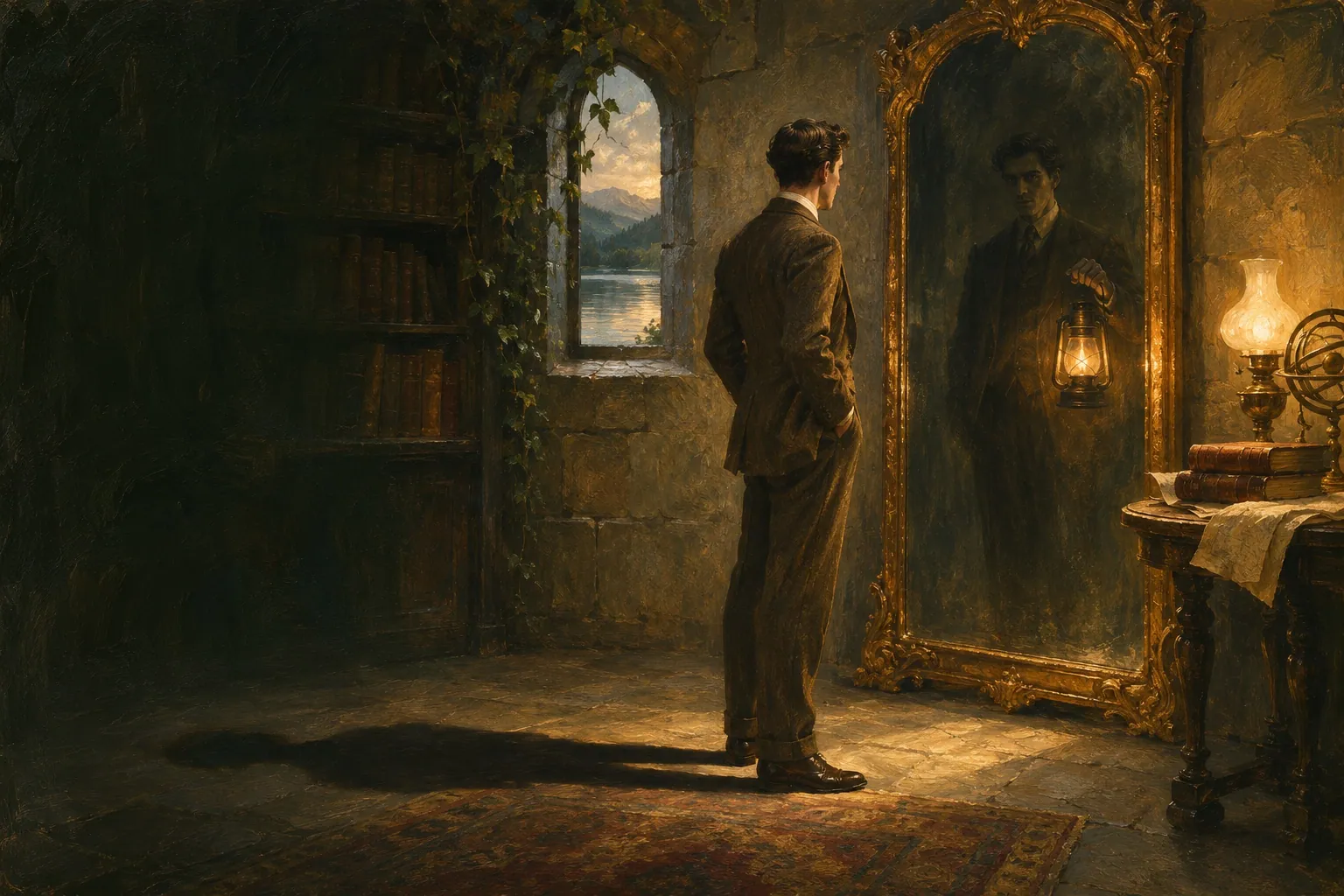
"Shadow work" may be the biggest self-help phrase of the decade: journals, prompts, workbooks, thirty-day challenges. Nearly all of it claims to come from Carl Jung, the Swiss psychiatrist who broke with Freud and mapped the unconscious in his own way. But very few shadow-work guides quote him, and when they do, the quote is often made up.
So here is the real thing: what Jung wrote about the shadow, the mask we show the world, and the "other side" of our nature, from the early books of his that are now in the US public domain.
The shadow, in Jung's words
Jung did not invent the phrase "shadow work," and he wrote most of his famous pages on the shadow in the 1940s and 1950s, in books still under copyright. But the idea is already there, clearly, in Two Essays on Analytical Psychology, published in English in 1928:
Since human nature is not constituted wholly of light, but also abounds in shadows, the insight and understanding gained in practical analysis is often somewhat painful, all the more painful, of course, the more one has previously neglected the other side.
The shadow, for Jung, is everything in us that does not fit the picture we have of ourselves: the impulses, weaknesses, angers and also unlived gifts we push out of awareness. And because we cannot see it, we cannot deal with it:
This shadow side of the mind, being withdrawn from conscious scrutiny, cannot be dealt with by the patient.
He adds a warning that modern shadow work often forgets: some people take their new self-knowledge "very much to heart, too much so in fact, forgetting that they are not unique in having a shadow side." Everyone has one. That is the point.
Two Essays on Analytical Psychology
C. G. Jung · 1928
The two essays where Jung lays out the shadow side, the persona, the collective unconscious and individuation. The best single starting point.
The persona: the mask
Shadow work only makes sense next to its opposite. Jung called the face we show the world the persona, after the masks of ancient actors:
The word 'persona' is really a very suitable expression for it; since persona originally meant the mask worn by an actor.
The persona is not bad. We need it to live with other people. The trouble comes when we believe the mask is all we are. "When we analyse the persona we take off the mask," Jung writes, and discover that much of what seemed most personal is borrowed.
Individuation: the point of it all
Why face your shadow? Jung's answer is individuation: becoming the whole, particular person you actually are, rather than a copy of the collective. "Individuation, therefore, is a process of differentiation, having for its goal the development of the individual personality." He calls individuality a "tender plant," easily smothered by the pressure to imitate.
Shadow work, done well, is just this: noticing what you have pushed away, owning it, and becoming more whole and less divided.
Introvert and extravert: Jung's words, too
Jung gave the world another pair of words you use every day. In Psychological Types (1921), he described two basic attitudes, introversion (energy turned inward) and extraversion (energy turned outward), and four functions: thinking, feeling, sensation and intuition. The Myers-Briggs test is built on it. And in Two Essays he links the types back to the shadow: in the introvert, he says, extraversion "lies sleeping and undeveloped in the background," and the reverse in the extravert. Your undeveloped side is part of your shadow.
C. G. Jung · 1923
The 1921 book that gave us introvert and extravert, and the root of the Myers-Briggs.
Collected Papers on Analytical Psychology
Jung's early papers, including where he first sets out introversion and extraversion.

The 1912 book that broke Jung's friendship with Freud: myth, symbol and the libido.
(Jung's books from these years are public domain in the United States, but some may be hidden in countries where they are still under copyright.)
Some shadow-work prompts from Jung's ideas
These are ours, built on the passages above, not quotes:
- What trait in other people irritates me far more than it should? Where might it live in me?
- What do I say "I would never" about? What would it mean if I could?
- What does my persona at work or online hide that the people closest to me know?
- If I am an introvert, what extravert gift have I left undeveloped, or the reverse?
- What compliment do I always deflect? (The shadow holds unlived gifts, too.)
Questions people ask
- What is shadow work according to Carl Jung?
- Jung did not use the phrase, but he taught that the "shadow side" of the mind holds what we refuse to see in ourselves, and that bringing it into awareness, painful as that is, is necessary for becoming whole, which he called individuation.
- What did Jung say about the shadow?
- In Two Essays on Analytical Psychology he wrote that "human nature is not constituted wholly of light, but also abounds in shadows," and that the shadow side, "withdrawn from conscious scrutiny," cannot be dealt with until it is seen.
- What is the persona in Jungian psychology?
- The mask we present to the world. Jung took the word from the masks worn by actors in ancient theater.
- Can I read Carl Jung's books for free?
- His early books in English, including Two Essays on Analytical Psychology and Psychological Types, are in the US public domain and free to read here.
Every book in this post
Free to read online, download, or send to your Kindle.

Two Essays on Analytical Psychology
Cover of Two Essays on Analytical PsychologyTwo Essays on Analytical Psychology
C. G. Jung · 1928

Psychological Types
Cover of Psychological TypesPsychological Types
C. G. Jung · 1923
Collected Papers on Analytical Psychology

Psychology of the Unconscious


Keep reading
The public domain
Public Domain Day 2027: the books, films and songs of 1931 that become free
Dracula, Frankenstein, The Good Earth, Faulkner, Hammett, Nancy Drew and "As Time Goes By": on January 1, 2027, works from 1931 enter the US public domain. Here is what is coming, and the fine print.
Dreams
What your dreams meant in 1901: teeth, snakes, falling and flying
Teeth falling out, being chased by snakes, flying, falling, showing up naked: here is what the most popular dream dictionary ever printed said they meant, and what Freud said at the same moment.
Sacred texts
The real story of Hanukkah, from the Books of Maccabees
Why eight days? Is the miracle of the oil in the Bible? Who were the Maccabees? The story of Hanukkah as the ancient books tell it, with the verses that set the festival.