
Vampires never really go away, but they are having a particularly big moment: Robert Eggers's Nosferatu, Ryan Coogler's Sinners, endless series and novels. The vampire on screen is a seductive aristocrat in a cape. The vampire of the old reports was something else entirely: a dead peasant who would not stay in his grave.
The best guide to those old reports is Vampires and Vampirism (1913), by the English writer Dudley Wright, who collected them from the eighteenth-century sources. As he puts it:
A living dead body! The words are idle, contradictory, incomprehensible, but so are vampires.
The case of Peter Plogojowitz
In the 1720s, after a war with the Ottomans, the Habsburg Empire took over parts of what is now Serbia, and its officials began to send home strange reports from the villages. One of the first, which Wright quotes from an early German treatise, concerns a peasant named Peter Plogojowitz, who:
after he had been buried more than ten years, appeared by night to several persons in the village, while they were asleep, and squeezed their throats in such a manner that they expired within twenty-four hours.
Nine people died in eight days. His widow said he had visited her too, "and that his errand was to demand his shoes." The villagers dug up the body and burned it.
Arnod Paole and the army surgeons
The most famous case came from the village of Medvegja, near Belgrade. Wright reproduces it from an official document "signed by three regimental surgeons and formally countersigned by the lieutenant-colonel and sub-lieutenant," dated June 7, 1732.
A former soldier named Arnod Paole had come home, bought a cottage, and then died in an accident. Soon villagers said he was walking at night, and people began to die. The authorities opened his grave. The body seemed fresh, with new skin and nails beneath the old:
So, without more ado, they simply drove a stake through poor Arnod's chest, whereupon a quantity of blood gushed forth, and the corpse uttered a dreadful groan.
They then staked and burned four others he was thought to have infected. Reports like this, with the signatures of educated officials, caused a sensation across Europe in the 1730s, and they are a big part of how the word "vampire" entered English and other Western languages.
Wright explains how such bodies were dealt with. A stake through the heart, ideally with one single blow, since the Russians said "a second blow will reanimate the corpse." Or, in stubborn cases, "to cut off the head, fill the mouth with garlic, and then replace the head in its proper place in the coffin."
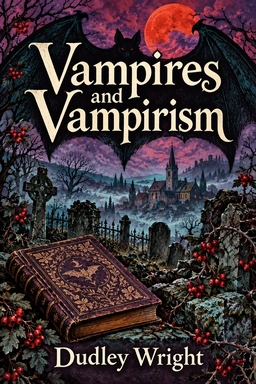
Dudley Wright · 1914
Dudley Wright's 1913 collection of real vampire reports from Serbia, Hungary, Greece, Russia and beyond.
Where "nosferatu" comes from
The word Nosferatu sounds like a name, but in the old books it is a folk term. Wright records the Transylvanian belief:
In Transylvania, the belief prevails that every person killed by a nosferatu (vampire) becomes in turn a vampire, and will continue to suck the blood of other innocent people until the evil spirit has been exorcised.
The word was popularized in English by Victorian travel writers on Transylvania, and Bram Stoker used it in Dracula. The 1922 German film Nosferatu took it as a title, and it has stuck.
The night of Frankenstein: the first vampire story
The vampire became a gentleman on one famous night. In June 1816, at the Villa Diodati on Lake Geneva, Lord Byron, Percy Shelley, Mary Godwin (soon Mary Shelley) and Byron's young doctor, John Polidori, were reading ghost stories. The introduction to Polidori's tale tells it:
It was afterwards proposed, in the course of conversation, that each of the company present should write a tale depending upon some supernatural agency, which was undertaken by Lord B., the physician, and Miss M. W. Godwin.
Mary's story became Frankenstein. Byron abandoned his. Polidori took Byron's fragment and wrote The Vampyre, the first vampire story in English prose, published in 1819 and at first credited to Byron. Its vampire, Lord Ruthven, is a cold, magnetic English nobleman, widely read as a portrait of Byron himself. People feared him without knowing why:
some attributed it to the dead grey eye, which, fixing upon the object's face, did not seem to penetrate, and at one glance to pierce through to the inward workings of the heart.
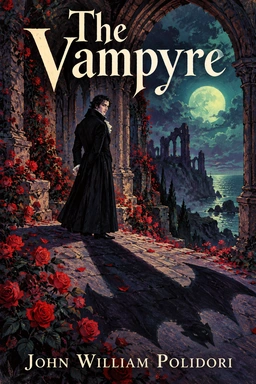
John William Polidori · 1819
Polidori's 1819 tale, the first vampire story in English prose, born on the same night as Frankenstein.
Varney, Carmilla, Dracula
Three more books finished the job. Varney the Vampire (1845 to 1847) was a sprawling penny dreadful that gave vampires fangs and a sympathetic, tormented side. Sheridan Le Fanu's Carmilla (1872) made the vampire a beautiful young woman, Mircalla, Countess Karnstein, who visits a lonely girl in a Styrian castle and whispers:
In the rapture of my enormous humiliation I live in your warm life, and you shall die—die, sweetly die—into mine.
And in 1897, Bram Stoker drew on all of them, and on the folklore of Transylvania, for Dracula: "Listen to them—the children of the night. What music they make!"
One surprise for modern readers: Stoker's Count is not destroyed by sunlight. He walks in the daytime, only weaker. "His power ceases, as does that of all evil things, at the coming of the day," Van Helsing says. The idea that sunlight kills vampires came later, from the 1922 film Nosferatu.


For more strange folklore from the old books, see the Nephilim and the giants of ancient texts and the legend of Lilith, whom some later writers described as a kind of vampire.
Questions people ask
- Were vampires real?
- No, but the panic was. In the 1720s and 1730s, officials in Habsburg-ruled Serbia reported villagers digging up corpses they believed were killing the living, and staking or burning them. The best-known case is Arnod Paole in 1732.
- What does nosferatu mean?
- In the old folklore books it is a Transylvanian word for a vampire. Dudley Wright records the belief that "every person killed by a nosferatu (vampire) becomes in turn a vampire."
- What was the first vampire story?
- In English prose, John Polidori's The Vampyre (1819), begun on the same 1816 night at Lake Geneva when Mary Shelley conceived Frankenstein.
- Does sunlight kill Dracula?
- Not in the novel. Stoker's Count walks by day, though "his power ceases" at dawn. Death by sunlight was introduced by the 1922 film Nosferatu.
Every book in this post
Free to read online, download, or send to your Kindle.


Keep reading
Lost books of the Bible
The Nephilim: what the Bible, Enoch and the old legends say about the giants
"There were giants in the earth in those days." Genesis gives the Nephilim two verses. Enoch, Jubilees and Jewish legend tell the rest, down to a giant who rode out the Flood on the ark's roof.
Lost books of the Bible
Lilith, the first wife of Adam: where the legend really comes from
She is not in Genesis, yet she is everywhere: tattoos, tarot, TV. Here is the real history of Lilith, from a Babylonian night demon to the medieval tale of Adam's rebellious first wife.
Sacred texts
The real story of Hanukkah, from the Books of Maccabees
Why eight days? Is the miracle of the oil in the Bible? Who were the Maccabees? The story of Hanukkah as the ancient books tell it, with the verses that set the festival.