
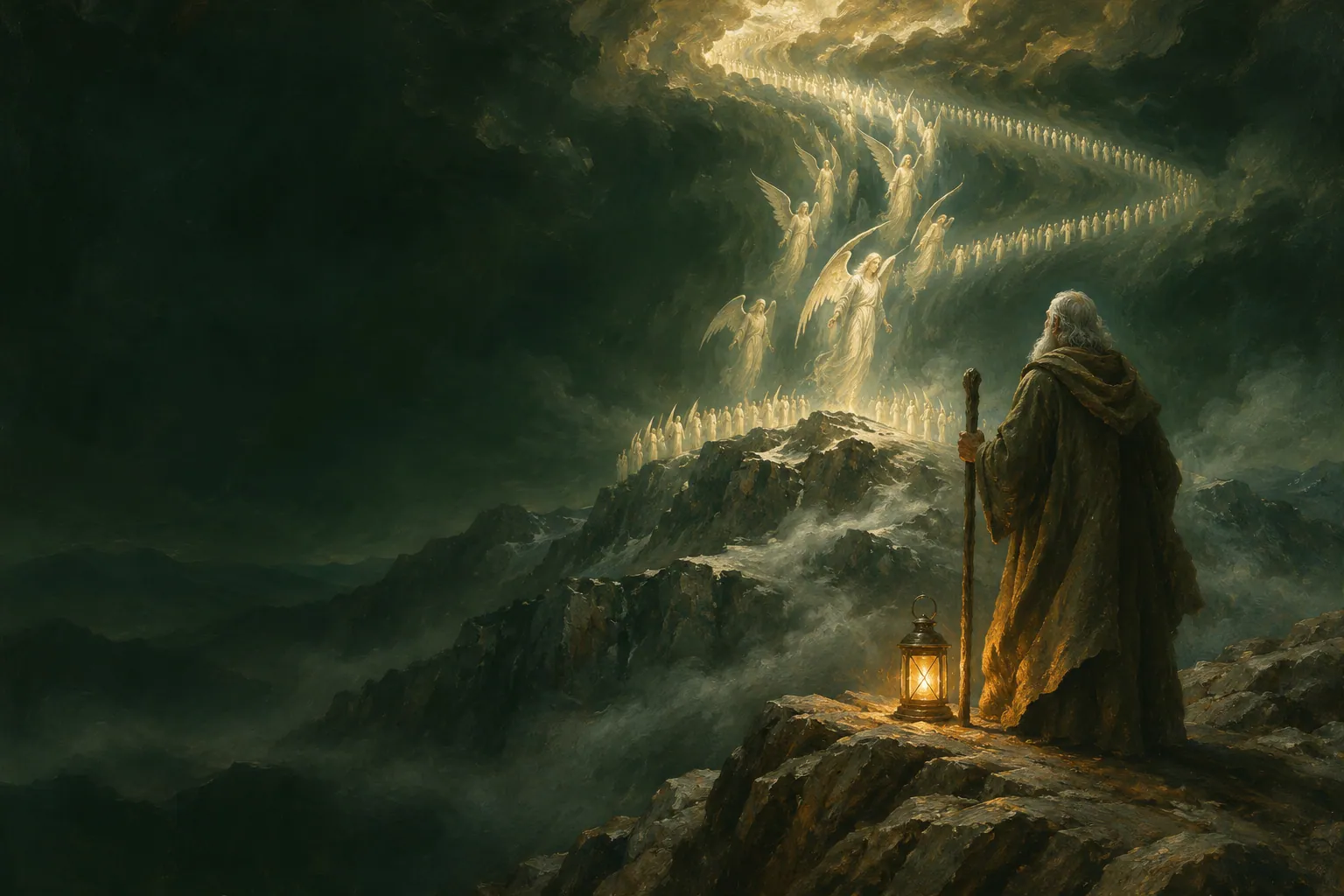
Genesis gives Enoch four sentences. He was the seventh generation from Adam, he lived 365 years, and then: "Enoch walked with God: and he was not; for God took him." That is all. No death, no burial, no explanation.
For the people who wrote the Book of Enoch, those four sentences were an invitation. A man who never died must have seen things. So they wrote down what he saw: the angels who fell, the giants they fathered, the paths of the sun and moon, the end of the world. The result is one of the strangest and most influential books of the ancient world, and most Christians have never read it.
Translated by R. H. Charles
R. H. Charles's translation, the one scholars still cite. Start here if you want the whole book in clear English.
The short answer
The Book of Enoch was never really removed from the Bible, because it was never part of the Hebrew Bible to begin with. It was written by several Jewish authors between roughly the third and first centuries before Christ, it circulated widely, and it was read and quoted as sacred by some Jews and many early Christians. When the canons of scripture settled, it did not make the cut almost everywhere. The great exception is Ethiopia, where the Orthodox Church has kept it in its Bible from late antiquity until today.
So the better question is why a book that the New Testament itself quotes was set aside. The answer comes in three parts: who wrote it, what it says, and who was deciding.
The New Testament quotes it
This is the detail that sends most readers looking. The little Epistle of Jude, near the end of the New Testament, quotes Enoch by name:
And Enoch also, the seventh from Adam, prophesied of these, saying, Behold, the Lord cometh with ten thousands of his saints, to execute judgment upon all.
Those words come almost directly from the first chapter of the Book of Enoch. Jude's readers clearly knew the book and took it seriously. Many scholars also hear echoes of Enoch in 1 Peter's "spirits in prison" and in the Son of Man language of the Gospels.
What the Book of Enoch actually says
The book is really five books stitched together, written at different times:
- The Book of the Watchers (chapters 1 to 36): the fall of the angels, and Enoch's journeys through heaven and the ends of the earth.
- The Parables, or Similitudes (37 to 71): visions of a heavenly judge called the Elect One and the Son of Man.
- The Astronomical Book (72 to 82): the courses of the sun, moon and stars, and a 364-day calendar.
- The Dream Visions (83 to 90): the whole history of Israel told as an allegory of animals.
- The Epistle of Enoch (91 to 108): warnings to the rich and comfort for the righteous.
The part everyone remembers is the first. Genesis 6 mentions, very briefly, that "the sons of God" took human wives and that there were giants, the Nephilim, in those days. Enoch tells the full story. Two hundred angels, the Watchers, swear an oath together and come down:
And they were in all two hundred; who descended in the days of Jared on the summit of Mount Hermon.
Their leader is Semjaza. Another, Azazel, teaches men to make swords and shields, and teaches women the arts of jewelry and painting the eyes. Others teach sorcery, the cutting of roots, astrology and the signs of the moon. Their children are giants who devour everything humans grow, and then devour humans. The Flood, in this telling, is God's answer to the Watchers.


Why it was set aside
It was never in the Jewish canon. The rabbis who shaped the Hebrew Bible did not include it, and later Jewish tradition grew wary of its angel stories. A Christian Old Testament built on the Hebrew Bible inherited that gap.
Nobody believed Enoch wrote it. Early Christian writers knew it claimed to come from a man who lived before the Flood. Tertullian, around the year 200, defended it anyway and argued that Noah could have preserved it. Augustine, two centuries later, was not convinced: he wrote that its great age made it impossible to trust, and that it was set aside because its origin could not be proved. Jerome counted it among the apocrypha.
Its theology was uncomfortable. If evil came into the world through rebel angels teaching forbidden arts, what happens to the story of Adam's sin? Later theologians also grew uneasy with the idea of angels marrying women, and preferred to read the "sons of God" of Genesis 6 as the descendants of Seth.
It simply stopped being copied. Once a book is not read in church, nobody pays scribes to copy it. By the Middle Ages the Book of Enoch had vanished from Europe almost entirely, surviving in quotations and a few Greek fragments.
Lost, then found twice
In 1773 the Scottish explorer James Bruce came home from Abyssinia with copies of the book in Ge'ez, the old church language of Ethiopia. Fifty years later Richard Laurence, an Oxford professor of Hebrew who became Archbishop of Cashel, published the first English translation.
Translated by Richard Laurence
Laurence's 1821 translation, the first in English, with an introduction asking whether the book was wrongly left out.
Then, in the twentieth century, the caves at Qumran gave up the Dead Sea Scrolls, and among them were fragments of Enoch in Aramaic, older than any Ethiopian copy by more than a thousand years. Whatever else it was, the book was real, ancient, and read by the same community that preserved the oldest copies of Isaiah.
The other Enoch books
There is more than one. 2 Enoch, also called The Secrets of Enoch, survived only in Old Church Slavonic. It follows Enoch up through ten heavens and was unknown in the West until the nineteenth century. 3 Enoch is a later Hebrew mystical text, and it is here too. And the Book of Jubilees, a retelling of Genesis that leans heavily on Enoch's calendar and angels, is also in the Ethiopian Bible.
The Book of the Secrets of Enoch
W. R. Morfill and R. H. Charles · 1896
2 Enoch, the Slavonic book, in its first English translation.
R. H. Charles · 1902
The "Little Genesis," which shares Enoch's angels and calendar.
If you want everything in one place, R. H. Charles also gathered these books with their notes into a single great collection, The Apocrypha and Pseudepigrapha of the Old Testament, Volume 2. And if this is the start of a longer road, our reading path Enoch and the lost books puts them in order.
Should you read it?
Yes, if you read it for what it is: not a forgery and not a secret gospel, but a window into what Jews believed in the centuries just before Jesus, and into the world the earliest Christians lived in. It is vivid, strange, and much more readable than its reputation. The Book of the Watchers takes an evening. If you are coming to it from the giants and the Nephilim, read chapters 6 to 16 first and keep going.
Questions people ask
- Is the Book of Enoch in the Bible?
- Not in Catholic, Protestant or most Orthodox Bibles. It is part of the Bible of the Ethiopian Orthodox Tewahedo Church, and the Epistle of Jude in the New Testament quotes it directly.
- Who wrote the Book of Enoch?
- Several unknown Jewish authors, writing between about 300 and 100 BC, under the name of Enoch. The oldest parts, the Book of the Watchers and the Astronomical Book, are probably the earliest.
- Is the Book of Enoch in the Dead Sea Scrolls?
- Yes. Aramaic fragments of most of its sections were found at Qumran, though not the Parables (chapters 37 to 71).
- Where can I read the Book of Enoch for free?
- Here: R. H. Charles's translation and Richard Laurence's 1821 translation are both free to read online or download, with no account needed.
Every book in this post
Free to read online, download, or send to your Kindle.
The Book of Enoch
Translated by R. H. Charles
The Book of Enoch the Prophet
Translated by Richard Laurence
The Book of the Secrets of Enoch
W. R. Morfill and R. H. Charles · 1896
The Book of Jubilees
R. H. Charles · 1902
3 Enoch
Hugo Odeberg · 1928
The Apocrypha and Pseudepigrapha of the Old Testament, Volume 2
R. H. Charles · 1913


Keep reading
Lost books of the Bible
The Nephilim: what the Bible, Enoch and the old legends say about the giants
"There were giants in the earth in those days." Genesis gives the Nephilim two verses. Enoch, Jubilees and Jewish legend tell the rest, down to a giant who rode out the Flood on the ark's roof.
Lost books of the Bible
The Book of Jasher: is it the lost book the Bible quotes?
The Bible quotes the Book of Jasher twice, then it vanishes. In 1840 a New York publisher printed one. Is it the real thing? Here is the honest history, what is inside, and where to read it free.
Lost books of the Bible
The books removed from the Bible, and where to read every one
The 1611 King James Bible had fourteen more books than yours. Here is what was taken out, why, and the lost gospels that never got in, all free to read.