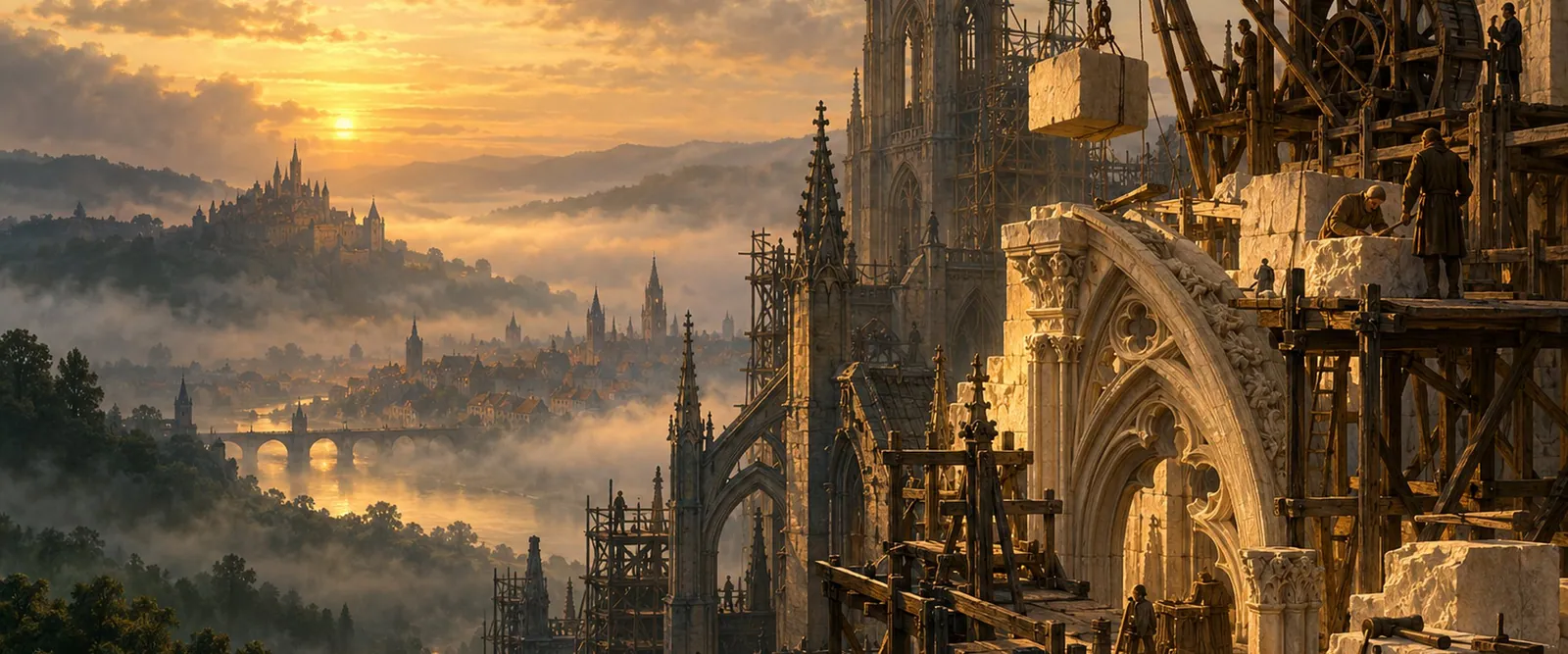
Among the wonderful monuments to which the religious art of the middle ages has given rise and which will for ever excite the admiration of men, the church of Notre-Dame or Cathedral of Strasburg occupies one of the first ranks. By its dimensions, the richness of the ornaments and figures that adorn its exterior, by the majesty of its nave, and by its light steeple, which towers towards Heaven with as much grace as boldness, this house of God proclaims afar its destination and leaves a deep and indelible impression on the soul of any one who gazes on it.
Exhibiting in all its different parts models of every epoch of christian architecture, this Cathedral is for the artist a subject of serious study and for the inhabitant of Strasburg a venerable monument, which recalls to his mind the principal events of the ancient history of our city.
According to some old traditions, the Cathedral is built on a spot, which, from the remotest times, had been devoted to worship. Originally this spot formed a hill sloping westward into a cavity, which was filled up many centuries ago. Around it, the Celts, the first inhabitants of our country, built their huts: its summit was covered by the sacred wood, in the midst of which rose the druidical dolmen. It was there that those barbarians offered sacrifices to Esus, their God of war, sacrifices which, in times of public calamity, were human victims.
After the conquest of Gaul by the Romans, a regular and fortified town was very soon founded on the place hitherto occupied by the scattered habitations of the Celts. The old name of Argentorat was alone preserved; it signified a town where the river is crossed over. It was there, according to tradition, that a temple dedicated to Hercules and Mars succeeded the druidical forest. There is nothing unlikely in these traditions; the high ground on which the Cathedral stands speaks as much in their favour as the pagan statues found in the neighbourhood.