Please take a look at the important information in this header. We encourage you to keep this file on your own disk, keeping an electronic path open for the next readers. Do not remove this.
**Welcome To The World of Free Plain Vanilla Electronic Texts**
The Tragedie of Othello, the Moore of Venice
by William Shakespeare
*****This file should be named 2267.txt or 2267.zip******
We are now trying to release all our books one month in advance of the official release dates, leaving time for better editing.
We need your donations more than ever!
For these and other matters, please mail to:
When all other email fails...try our Executive Director: Michael S. Hart <hart@pobox.com> hart@pobox.com forwards to hart@prairienet.org and archive.org if your mail bounces from archive.org, I will still see it, if it bounces from prairienet.org, better resend later on....
We would prefer to send you this information by email.
Mac users, do NOT point and click, typing works better.
Example FTP session:
(Three Pages)
Some states do not allow disclaimers of implied warranties or the exclusion or limitation of consequential damages, so the above disclaimers and exclusions may not apply to you, and you may have other legal rights.
Executive Director’s Notes:
Barnardo. Who’s there? Fran. Nay answer me: Stand & vnfold your selfe
Bar. Long liue the King
As I understand it, the printers often ran out of certain words or letters they had often packed into a “cliche”...this is the original meaning of the term cliche...and thus, being unwilling to unpack the cliches, and thus you will see some substitutions that look very odd...such as the exchanges of u for v, v for u, above...and you may wonder why they did it this way, presuming Shakespeare did not actually write the play in this manner....
The answer is that they MAY have packed “liue” into a cliche at a time when they were out of “v”’s...possibly having used “vv” in place of some “w”’s, etc. This was a common practice of the day, as print was still quite expensive, and they didn’t want to spend more on a wider selection of characters than they had to.


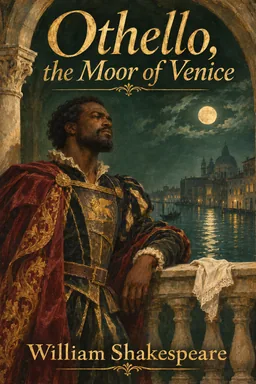 Othello, the Moor of Venice