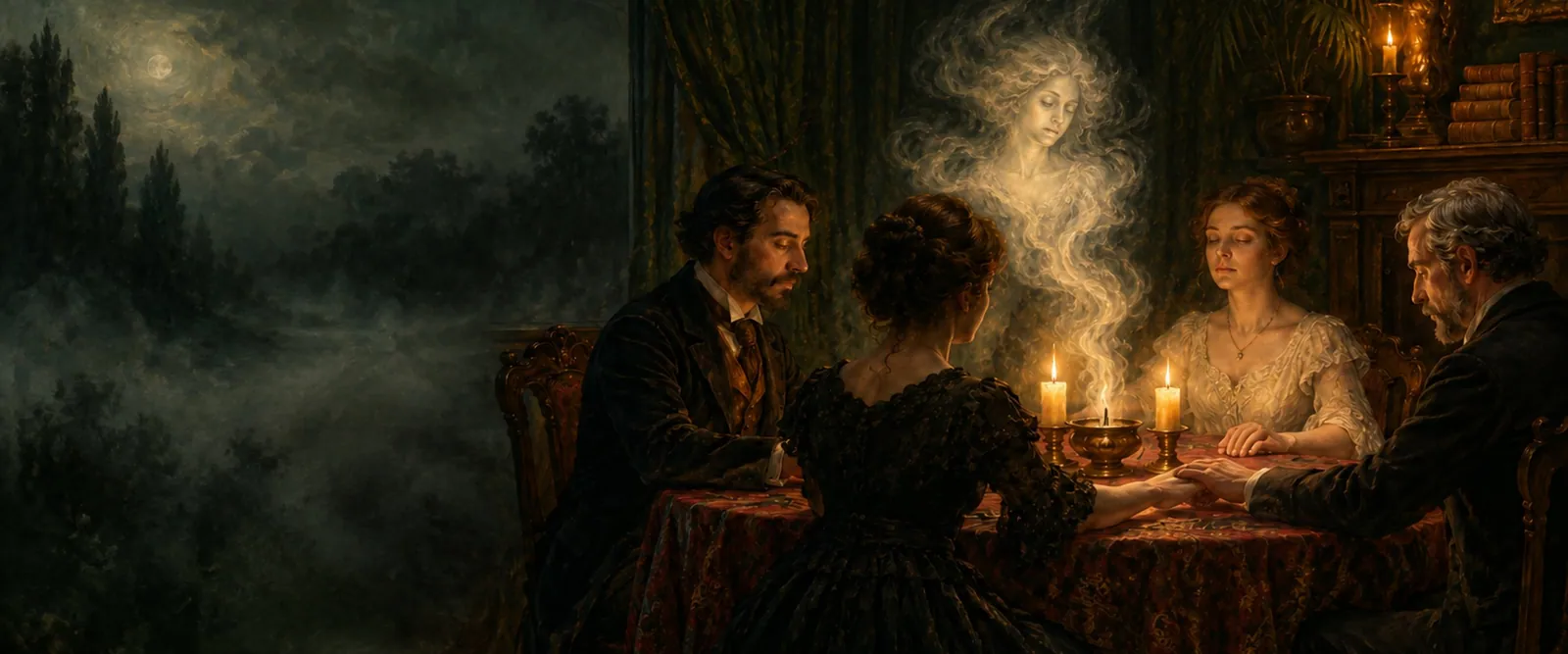
Expert writers believed twenty years ago that Spiritualism was declining. The late Mr. Frank Podmore, about the time of Queen Victoria’s Diamond Jubilee, called attention to the disappointing results attained by the Society for Psychical Research. The number of believers, he said, had been much larger in the seventies, and the things they believed much more difficult of acceptance. There was a time, he thought, when the number of avowed Spiritualists in this country and the United States might fairly have been reckoned by tens of thousands, but between 1882 and 1897 (the first period of the Society’s investigations) zealous students had been brought up against defeat. “No positive results,” he said frankly, “have been obtained worthy of record.” There was a “cooling-off” in public interest. Sir William Crookes, though a believer in Spiritualism, had seemed to discourage intrusive curiosity in a famous passage. “In such an inquiry,” he wrote, “the intellect demands that the spiritual proof must be absolutely incapable of being explained away; it must be so strikingly and convincingly true that we cannot, dare not, deny it.”
The truth is that Spiritualism breaks like waves on the modern world; and when each successive wave has spent its force there follows a period of lassitude. Can we wonder that a tidal wave should have followed the late war? Three classes, at least, have felt themselves strongly attracted towards psychical studies.
There are, first, the idle, curious gazers who under the late Roman Empire would have been thronging to the worship of Isis or Mithra. Sir Samuel Dill and Dr. Reaveley Glover have painted these men and women, some of whom had great possessions. Their successors were found in Paris under the Second Empire, when society, for a short time, was bewitched by the revelations of Douglas Home. Neither time nor space, it was believed, had any existence for him. Through his means the spirits of St. Louis, Pascal, Rousseau, and even ancient Greeks like Aristides and Solon, were consulted, and if we may trust French memoir-writers of the period, they replied with touching alacrity. Père Lacordaire, the foremost preacher of his time, was almost deceived by the phenomena.