In order to make the book of greatest value to you, I would urge you not only to read and study it, but also to make the excursions suggested and to perform the experiments. In other words, it will be of much greater value to you if you will make the observations and investigations and find out for yourselves the important facts and principles rather than simply take statements of the book unquestioned.
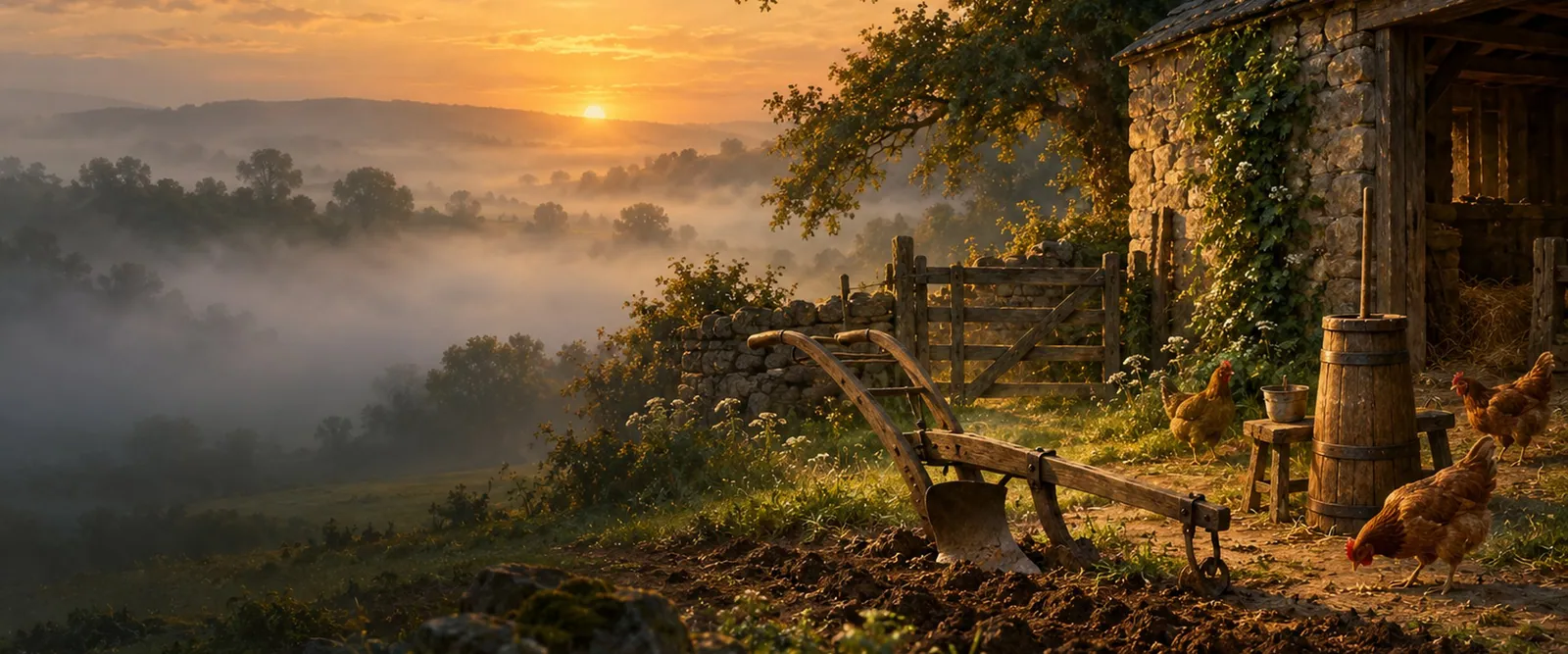
As we approach the farm we will probably see first the farm-house surrounded by shade trees, perhaps elms or maples, with the barns and other buildings grouped nearby. As we pass up the front walk we notice more or less lawn of neatly clipped grass, with flower beds bordering the walk, or we may find a number of chickens occupying the front yard, and the flower beds, placed in red half-barrels, set upon short posts. In the flower beds we may find petunias, nasturtiums, geraniums, rose bushes and other flowering plants. Going around the house, we come upon the dairy, with its rack of cans and pans set out for the daily sunning and airing. Nearby is a well with its oaken bucket; at the barn we find the farmer, and he very kindly consents to go with us to answer questions. In the barn and sheds we find wagons, plows, harrows, seed drills, hoes, rakes, scythes and many other tools and machines. Passing on to the fields, we go through the vegetable garden, where are carrots, parsnips, cabbages, beets, celery, sage and many other vegetables and herbs.
On the right, we see a field of corn just ready to harvest, and beyond a field of potatoes. On the left is the orchard, and we are invited to refresh ourselves with juicy apples. In the field beyond the hired man is plowing with a fine team of horses. In the South we would find a field of cotton and one of sweet potatoes, and perhaps sugar cane or peanuts. We have not failed to notice the pig weeds in the corn field nor the rag weed in the wheat stubble, and many other weeds and grasses in the fence corners.