
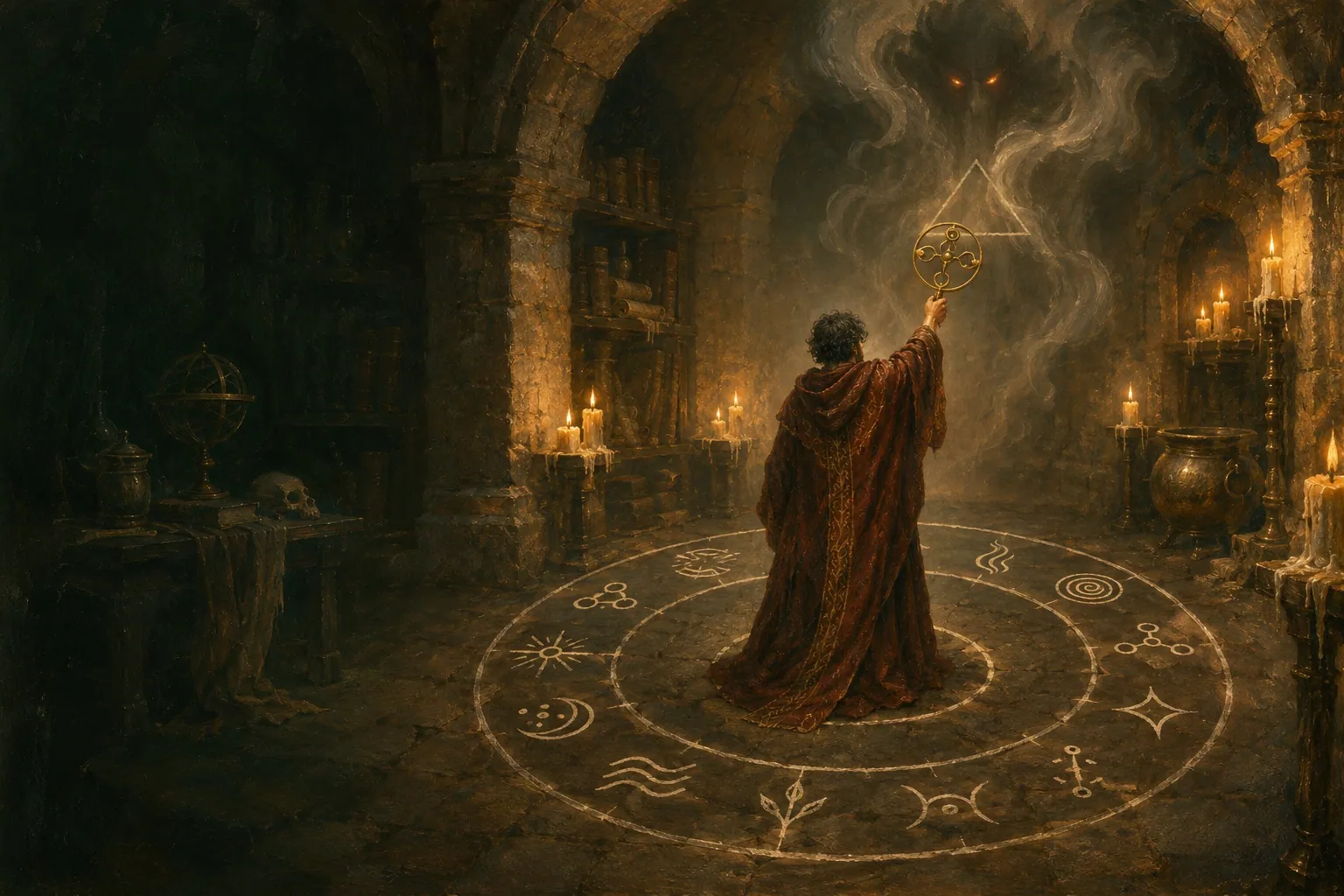
If you watch Hazbin Hotel or Helluva Boss, you already know some of these names. Stolas, the owl prince. His father Paimon. Andrealphus, the peacock. Asmodeus. The shows call their royal class of demons the Ars Goetia, and every one of those names comes from a real book: a seventeenth-century manual for summoning spirits, which claims to record the seventy-two demons King Solomon bound in a brass vessel.
Here is what that book actually says about them.
The Lesser Key of Solomon Goetia the Book of Evil Spirits
L. W. De Laurence · 1916
The Goetia itself, with all 72 spirits, their seals, and the full ritual. Every quotation below is from this edition.
What is the Ars Goetia?
Goetia is an old Greek word for sorcery. The Ars Goetia is the first of five parts of a grimoire called the Lemegeton, or Lesser Key of Solomon, compiled in England in the 1600s from older sources, especially a list of demons printed by the Dutch physician Johann Weyer in 1577. Weyer published his list to expose demon-summoning. The Lemegeton turned it back into a spellbook.
The English translation everyone reads was made by S. L. MacGregor Mathers, a founder of the Hermetic Order of the Golden Dawn, and published by Aleister Crowley in 1904. A Chicago publisher, L. W. de Laurence, reprinted it under his own name a few years later. That pirated edition, sold by mail order across America, is the one here.
The seventy-two, as the book describes them
Each spirit gets a number, a rank (king, prince, duke, marquis, earl, president), a shape, an "office" (what it can do for the magician), a number of legions under its command, and a seal. Some favorites:
Paimon (no. 9). A great king, "very obedient unto Lucifer."
He appeareth in the form of a Man sitting upon a Dromedary with a Crown most glorious upon his head. There goeth before him also an Host of Spirits, like Men with Trumpets and well sounding Cymbals.
Stolas (no. 36). In the Goetia he is not an owl at first sight but a raven, though other old demon lists make him an owl, and that is the image the show took.
He is a Great and Powerful Prince, appearing in the Shape of a Mighty Raven at first before the Exorcist; but after he taketh the image of a Man. He teacheth the Art of Astronomy, and the Virtues of Herbs and Precious Stones.
Fans of the show will like that: Stolas the stargazer is right there in the source.
Andrealphus (no. 65). A marquis "appearing at first in the form of a Peacock, with great Noises." He teaches geometry and astronomy, and "can transform a Man into the Likeness of a Bird."
Asmoday (no. 32). Asmodeus, a great king with three heads, a bull's, a man's and a ram's, a serpent's tail, flames from his mouth, and feet "webbed like those of a Goose." He rides an infernal dragon.
Bael (no. 1). The first spirit, a king of the East, who appears as a cat, a toad, a man, or all three at once, and "maketh thee to go Invisible."
Belial (no. 68). "Created next after Lucifer," he appears as two beautiful angels in a chariot of fire, and must be given offerings or he will not tell the truth.
The book ends the list plainly: "These be the 72 Mighty Kings and Princes which King Solomon Commanded into a Vessel of Brass."
Where Solomon's demons come from
The idea is far older than the Lemegeton. In the Testament of Solomon, a Greek text from the early Christian centuries, the archangel Michael gives Solomon a ring engraved with a pentagram that lets him command every demon. He calls them up one by one, asks each its name and the angel that defeats it, and sets them to work building the Temple. Asmodeus is there already.
F. C. Conybeare · 1898
The ancient source of the legend: Solomon's ring and the demons who built the Temple.
S. L. MacGregor Mathers · 1889
The "Greater Key," a different and older grimoire of pentacles and planetary hours, also translated by Mathers.
Is it dangerous to read?
It is a book. A strange, specific, sometimes beautiful one: the trumpets before Paimon, the peacock noises of Andrealphus. Most people who read it now read it as history, as folklore, or because a TV show sent them looking, and it is a far richer story than any fan wiki. If you want the context of how people in earlier centuries thought about demons, these are the classics:


Questions people ask
- What is the Ars Goetia?
- The first book of the Lesser Key of Solomon (Lemegeton), a 17th-century grimoire listing 72 spirits that King Solomon was said to have bound, with their ranks, appearances, powers and seals.
- Is Stolas a real demon?
- Stolas is spirit number 36 in the Goetia, a "Great and Powerful Prince" who first appears as a raven and teaches astronomy and the virtues of herbs and precious stones. Other old lists picture him as an owl.
- Who is Paimon in the Goetia?
- Spirit number 9, a great king "very obedient unto Lucifer," who rides a dromedary, wears a glorious crown, and is preceded by spirits playing trumpets and cymbals.
- Can I read the Lesser Key of Solomon free?
- Yes. The Goetia is in the public domain and free to read here, along with the Testament of Solomon and the Key of Solomon.
Every book in this post
Free to read online, download, or send to your Kindle.


Keep reading
Forbidden knowledge
The two books that made the modern witch: the Malleus Maleficarum and Aradia
One was a 1486 manual for hunting witches. The other, from 1899, claimed to be the secret gospel of Italian witches and helped inspire Wicca. Here is what each actually says, in the free translations.
Sacred texts
The real story of Hanukkah, from the Books of Maccabees
Why eight days? Is the miracle of the oil in the Bible? Who were the Maccabees? The story of Hanukkah as the ancient books tell it, with the verses that set the festival.
Classic literature
A Christmas Carol explained: the story, the three spirits and what Dickens meant
What A Christmas Carol is really about: Scrooge, Marley's chain, the three spirits, Ignorance and Want, and why Dickens wrote it in six weeks in 1843. With the best lines, word for word.