

Every December, A Christmas Carol is back: on stage, on TV, as Muppets, as cartoons. The book itself is short, about 29,000 words, and it is sharper and stranger than most adaptations. Here is what happens, what Dickens meant by it, and the lines worth knowing word for word.
Why Dickens wrote it
In 1843 Charles Dickens was thirty-one, famous, and short of money. His latest novel, Martin Chuzzlewit, was selling badly. That same year he had read a government report on children working in mines and factories, and visited a "ragged school" for the poorest children in London. He was furious, and he first thought of writing a pamphlet.
Instead he wrote a ghost story. He finished it in about six weeks, paid to have it printed handsomely, and it came out on December 19, 1843. It sold out by Christmas Eve.
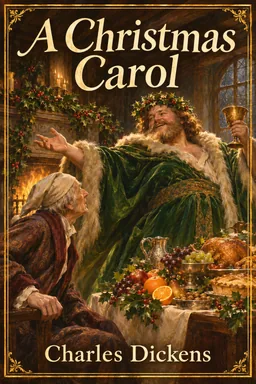
Charles Dickens · 1843
Dickens's own text, in five short "staves" (he called the chapters staves, like the verses of a song). A two-hour read, ideal for reading aloud over several nights.
Stave One: Scrooge and Marley's chain
The book opens with one of the most famous first lines in English: "Marley was dead, to begin with." Then Dickens introduces his miser in a single breath:
Oh! but he was a tight-fisted hand at the grindstone, Scrooge! a squeezing, wrenching, grasping, scraping, clutching, covetous old sinner!
When his nephew wishes him a merry Christmas, Scrooge answers with his trademark: "Bah! Humbug!" When two gentlemen ask him to give to the poor, he asks, "Are there no prisons?" and "And the Union workhouses? Are they still in operation?"
That night his dead partner, Jacob Marley, appears, wrapped in a chain of cash-boxes and ledgers. "I wear the chain I forged in life," he says. When Scrooge tries to comfort him that he was "always a good man of business," Marley cries out the heart of the whole book:
"Business!" cried the Ghost, wringing its hands again. "Mankind was my business. The common welfare was my business; charity, mercy, forbearance, and benevolence were, all, my business."
The three spirits
- The Ghost of Christmas Past shows Scrooge his lonely boyhood at school, his joyful early job with old Fezziwig, and the young woman he lost because he came to love money more.
- The Ghost of Christmas Present takes him to the Cratchits' tiny house, where Bob, his clerk, toasts him anyway, and Tiny Tim is ill. When Scrooge asks if Tim will live, the spirit throws his own words back at him: "If he be like to die, he had better do it, and decrease the surplus population."
- The Ghost of Christmas Yet to Come says nothing at all. It shows him a death nobody mourns, servants selling a dead man's bed-curtains, and finally a neglected grave with his own name on it.
Ignorance and Want: the scene most films cut
Near the end of Stave Three, the Ghost of Christmas Present opens his robe and shows two starved, wolfish children clinging to his legs. Scrooge asks if they are the spirit's children.
"They are Man's," said the Spirit, looking down upon them. "And they cling to me, appealing from their fathers. This boy is Ignorance. This girl is Want. Beware of them both, and all of their degree, but most of all beware this boy."
This is Dickens's pamphlet, folded into the story. The poverty of the 1840s was not a backdrop. It was his target, and ignorance, the lack of schooling for poor children, was in his eyes the greater danger.
The ending
Scrooge wakes on Christmas morning, alive and with time to change, and makes a vow:
I will honour Christmas in my heart, and try to keep it all the year. I will live in the Past, the Present, and the Future.
He sends the biggest turkey in the shop to the Cratchits, raises Bob's salary, and, in the book's final page, becomes "as good a friend, as good a master, and as good a man as the good old City knew." Tiny Tim, Dickens tells us, "did not die." The book ends with Tim's blessing: "God Bless Us, Every One!"
What it means
The Carol is often called the book that invented the modern Christmas, and in a sense it did: family dinners, generosity, the idea of a Christmas "spirit." But its message is not just "be nice at Christmas." It is that a life spent only on money is a kind of prison, that the poor are "fellow-passengers to the grave," as Scrooge's nephew puts it, and that it is never too late to change. Scrooge's redemption is a choice he makes, not a miracle done to him.
For the other book that shaped the modern Christmas, see the original 'Twas the Night Before Christmas.


Questions people ask
- What is the main message of A Christmas Carol?
- That greed shuts a person off from other people, that the poor are fellow human beings and not a "surplus population," and that anyone can change. Marley's line "Mankind was my business" sums it up.
- Who are the three ghosts in A Christmas Carol?
- The Ghost of Christmas Past, the Ghost of Christmas Present and the Ghost of Christmas Yet to Come. Before them comes the ghost of Scrooge's old partner, Jacob Marley, so Scrooge is visited by four ghosts in all.
- What do Ignorance and Want mean in A Christmas Carol?
- They are two starving children hidden under the robe of the Ghost of Christmas Present. They stand for the neglected poor of Victorian England. The spirit warns Scrooge to beware them both, "but most of all beware this boy," Ignorance.
- Why are the chapters called staves?
- Because Dickens framed the book as a carol, a song. A stave is a verse or stanza, so the five chapters are the five verses of his "carol."
- How long is A Christmas Carol?
- About 29,000 words, roughly two to three hours of reading.
Every book in this post
Free to read online, download, or send to your Kindle.
Keep reading
Myth and folklore
'Twas the Night Before Christmas: the original poem, the real reindeer names and who wrote it
The full original text of A Visit from St. Nicholas, why it ends "Happy Christmas", what happened to Dunder and Blixem, and the 200-year fight over who really wrote it.
Reading guides
EPUB vs PDF: which ebook format should you use?
EPUB or PDF? What each format is for, which one works on Kindle, Kobo, iPhone and Android, what happened to MOBI, and how to turn a PDF into an EPUB for free.
Reading guides
Why PDFs look terrible on a Kindle, and how to fix it for free
A PDF on a Kindle means tiny text, zooming and sideways scrolling. Here is why, and how to turn any PDF into a real ebook for Kindle, Kobo or Apple Books in a minute, free.