
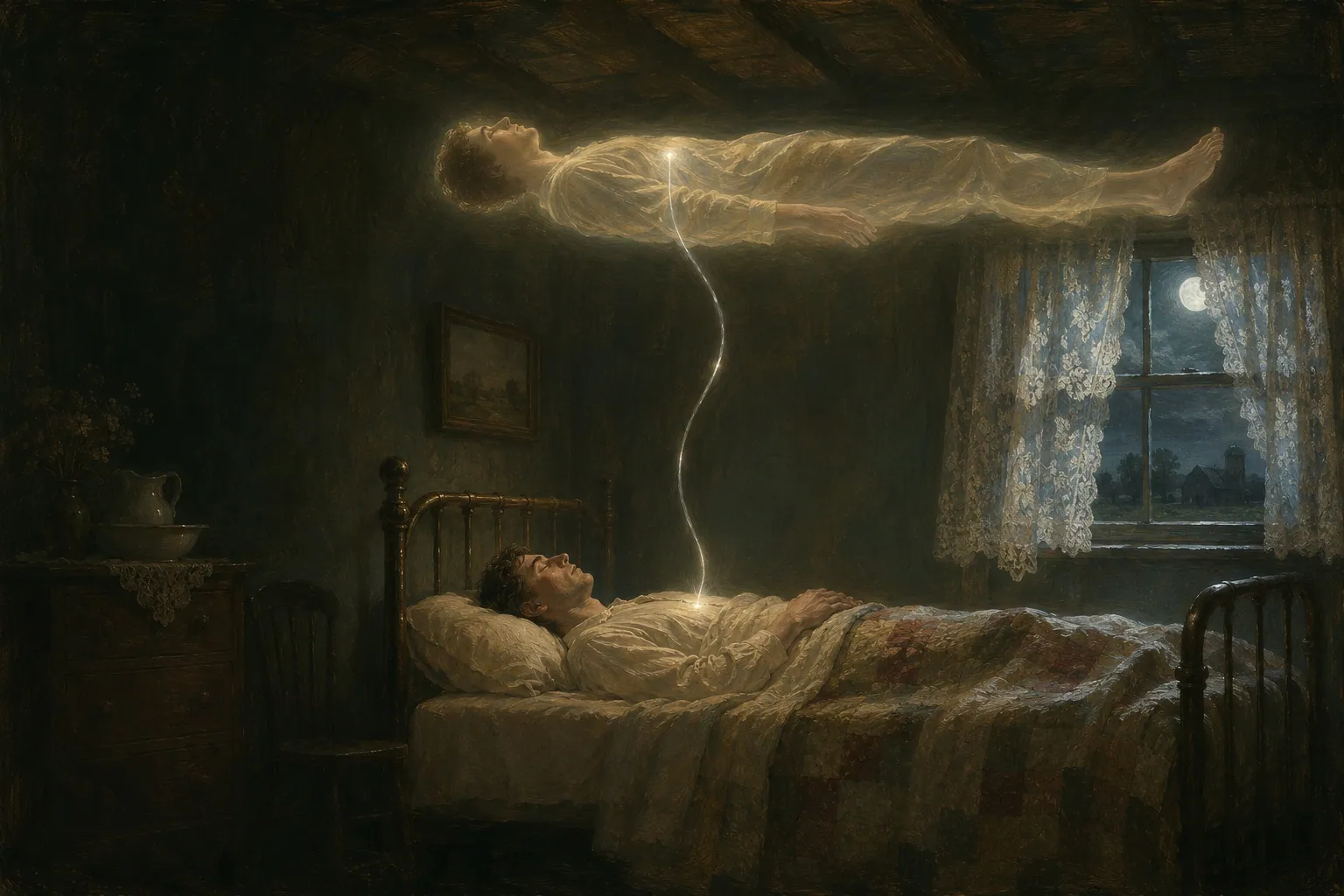
In the 1920s Hereward Carrington, one of America's best-known psychical researchers, received a letter from a young man in Wisconsin. It began:
I was much interested in your chapter on 'Astral Projection,' as I have been a 'projector' for twelve years — long before I knew that anyone else in the world ever did such things.
The young man was Sylvan Muldoon, still in his twenties and often ill, and he said that since boyhood he had found himself waking in the night outside his own body, joined to it by a cord. Carrington was impressed enough to write the introduction to Muldoon's book, The Projection of the Astral Body, published in 1929. Almost every guide to astral projection and lucid dreaming since, from the 1970s paperbacks to today's YouTube tutorials, repeats its ideas.

The Projection of the Astral Body
Sylvan Muldoon and Hereward Carrington · 1929
Muldoon and Carrington's 1929 classic: the experiences, the theory, and the methods.
The astral cord
The book's most famous image is the cord. Muldoon describes it, from his own projections, as a kind of elastic cable joining the "phantom" to the sleeping body, thick near the body and thinning with distance:
The astral and the physical bodies are invariably connected by means of a sort of cord, or cable, along which vital currents pass.
He maps its "range of activity," describes how a sudden noise can snap you back into your body with a jolt (the falling feeling many people get at the edge of sleep), and insists, reassuringly, that "the projector cannot get lost."
Method 1: dream control
Muldoon's main technique starts from dreams. His co-author Carrington gives the core of it, and it is the same method lucid dreamers now call wake-induced lucid dreaming:
As you are falling to sleep, hold this scene before you, and at the very last moment — before you fall asleep — consciously transfer yourself into the scene — in other words, step into the picture.
In practice: lie down, relax, and watch yourself falling asleep. Build a simple, definite scene in your mind, ideally one that involves movement, like rising in an elevator or floating up. Hold it until the very edge of sleep, and then step into it. Muldoon adds his own twist: choose a dream in which your body moves, because a dream of motion is the easiest one to wake up inside, already outside your body.
Readers of our post on Neville Goddard will recognize the state: Neville called it a "state akin to sleep," and used it for a different purpose.
Method 2: the thirst trick
This is the strangest and most memorable part of the book. Muldoon noticed that strong bodily desires, held unconsciously during sleep, could push the "phantom" out to satisfy them. His first deliberate method was thirst: swallow a pinch of salt before bed (he used about an eighth of a teaspoon), do not drink, and set up a habit of going to fetch water in a fixed place. As you fall asleep, imagine getting up, walking to the water, drinking. If it works, he says, you may find yourself doing it outside your body.
He also writes about "incapacity," the need to have the body completely still and relaxed, and about cultivating desire and will, which he calls the true motors of projection.
What is really happening?
Muldoon believed he was leaving his body. Sleep researchers today describe experiences like his in terms of sleep paralysis, hypnagogic imagery and lucid dreams, which can feel startlingly real. You do not have to settle that question to find the book fascinating, or to use its methods to have more vivid dreams. It is careful, honest about failures, and written by someone who clearly experienced what he describes.
More from the astral shelf

C. W. Leadbeater · 1895
C. W. Leadbeater's 1899 Theosophical map of the "astral world," which shaped how Muldoon's generation talked about it.

Swami Panchadasi · 1915
Swami Panchadasi (another of William Walker Atkinson's pen names) on the astral planes.


And for what the old books thought your ordinary dreams meant, see the 1901 dream dictionary.
Questions people ask
- What is astral projection?
- The experience of seeming to leave your physical body and travel in a second, subtle body, often while falling asleep or waking. Sylvan Muldoon's The Projection of the Astral Body (1929) is the classic first-hand account.
- What is the silver cord in astral projection?
- The cord or "cable" that Muldoon described joining the projected astral body to the sleeping physical body, along which he believed "vital currents" passed.
- What is the best technique for astral projection or lucid dreaming?
- The 1929 book's core method is dream control: watch yourself falling asleep, hold a vivid scene of movement in mind, and at the last moment "step into the picture." This is essentially what lucid dreamers now call wake-induced lucid dreaming.
- Is The Projection of the Astral Body free?
- Yes. It is free to read here.
Every book in this post
Free to read online, download, or send to your Kindle.


Keep reading
Eastern wisdom
The Tibetan Book of the Dead explained: the bardo, the Clear Light and the 49 days
Read aloud beside the dying, it guides the mind through 49 days between death and rebirth. Here is what the Bardo Thodol teaches, in the 1927 translation that inspired Jung, Leary and the Beatles.
Dreams
What your dreams meant in 1901: teeth, snakes, falling and flying
Teeth falling out, being chased by snakes, flying, falling, showing up naked: here is what the most popular dream dictionary ever printed said they meant, and what Freud said at the same moment.
Eastern wisdom
Kundalini awakening: what the old books say about the serpent, the chakras and the vagus nerve
Long before TikTok, a 1927 Bombay doctor argued that kundalini is the vagus nerve, and a famous occultist warned it could "tear tissues." Here is what the classic sources really teach.