

In 1927, an American scholar of religion named W. Y. Evans-Wentz published an English translation of a Tibetan Buddhist text and gave it a title borrowed from Egypt: The Tibetan Book of the Dead. The name stuck. The book went on to fascinate Carl Jung, became a manual for Timothy Leary's psychedelic experiments in the 1960s, and gave the Beatles the lyrics of "Tomorrow Never Knows." Today, with near-death experiences and "what happens when we die" content everywhere, it is more searched than ever.
So what does it actually say?
What the book is
Its Tibetan name is the Bardo Thodol, roughly "liberation through hearing in the intermediate state." It belongs to a cycle of teachings traditionally traced to Padmasambhava, the eighth-century teacher who brought Buddhism to Tibet. The translation was made by a Sikkimese lama, Kazi Dawa-Samdup, and edited by Evans-Wentz.
Its purpose is practical. A lama sits beside the dying person, and then beside the body, and reads the text aloud, speaking directly to the consciousness of the dead. The bardo is the in-between state that follows death, which the text says lasts forty-nine days before rebirth. The reading guides the dead through it, and gives them chance after chance to be liberated.
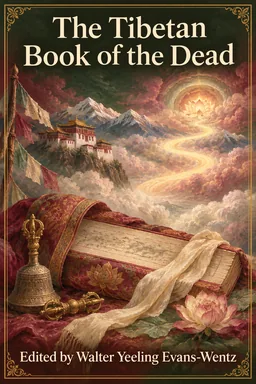
Walter Yeeling Evans-Wentz · 1927
The 1927 Evans-Wentz translation of the Bardo Thodol, with his introduction and notes. Free to read.
The moment of death: the Clear Light
The first and greatest opportunity comes at the instant of death. The reader whispers in the dying person's ear:
O nobly-born (so and so by name), the time hath now come for thee to seek the Path [in reality]. Thy breathing is about to cease.
At that moment, the text says, the mind meets the Clear Light, reality itself, "wherein all things are like the void and cloudless sky, and the naked, spotless intellect is like unto a transparent vacuum without circumference or centre." The instruction is simple: "At this moment, know thou thyself; and abide in that state." Recognize the light as your own true nature, and you are free.
The peaceful and wrathful deities
Most people do not recognize the light. So the dead pass into a second bardo, in which a series of visions appears over many days: first peaceful deities, surrounded by brilliant colored lights, then terrifying wrathful ones. Each time, the reader urges the dead not to run:
At that time fear not the glorious and transparent, radiant and dazzling green light, but know it to be Wisdom; and in that state allow thine intellect to rest in resignation.
And the central teaching, repeated again and again, is that none of it is outside you:
If thou knowest it to be the radiance of thine own intellect—although thou exertest not thy humility and faith and prayer to it—the Divine Body and Light will merge into thee inseparably, and thou wilt obtain Buddhahood.
Evans-Wentz sums it up in his introduction: the visions are "not visions of reality, but nothing more than the hallucinatory embodiments of the thought-forms born of the mental-content of the percipient."
Rebirth
If the dead still have not found liberation, they drift into the third bardo, the bardo of seeking rebirth, driven by desire and karma toward a new womb. Even here the text offers advice, on how to close the door to a bad rebirth and choose a good one.
Why Westerners fell for it
The book seemed to describe, centuries earlier, things the twentieth century was discovering: that the mind creates its own heavens and hells, and that what we meet after death, or in deep states of consciousness, might be our own projections. That is why Jung wrote about it, and why Leary and his colleagues turned it into The Psychedelic Experience (1964), a guide to LSD trips. Evans-Wentz himself opened his edition with a line from a medieval European book on the art of dying: "Thou shalt understand that it is a science most profitable, and passing all other sciences, for to learn to die."
Going further
For the Egyptian text it was named after, see the Egyptian Book of the Dead. And for the Western version of "leaving the body," see the 1929 guide to astral projection.


Questions people ask
- What is the Tibetan Book of the Dead?
- A Tibetan Buddhist text, the Bardo Thodol, read aloud to the dying and the dead to guide their consciousness through the bardo, the intermediate state between death and rebirth. It was first translated into English in 1927.
- What is the bardo?
- The intermediate state after death, which the text says lasts forty-nine days. The dead meet the Clear Light, then visions of peaceful and wrathful deities, and finally drift toward rebirth.
- What is the Clear Light?
- The vision of reality itself that the text says appears at the moment of death. Recognizing it as your own true nature brings liberation.
- Can I read the Tibetan Book of the Dead free?
- Yes. The 1927 Evans-Wentz translation is in the US public domain and free to read here.
Every book in this post
Free to read online, download, or send to your Kindle.

Keep reading
Ancient wisdom
The Egyptian Book of the Dead explained: the weighing of the heart and the 42 confessions
It was never one book, and the Egyptians never called it the Book of the Dead. Here is what they really buried with their dead: spells, the weighing of the heart, and the 42 "I have not" confessions.
Eastern wisdom
Kundalini awakening: what the old books say about the serpent, the chakras and the vagus nerve
Long before TikTok, a 1927 Bombay doctor argued that kundalini is the vagus nerve, and a famous occultist warned it could "tear tissues." Here is what the classic sources really teach.
The unseen
Astral projection and lucid dreaming: the 1929 book that started it all
The silver cord, the 'step into the picture' method, going to bed thirsty on purpose: a young man from Wisconsin wrote the original manual of out-of-body travel. Here is what it teaches, free.