

Long before habit-tracking apps, a young printer in Philadelphia ruled a little notebook in red ink and set out to make himself a better man, one virtue a week. His plan is still the clearest self-improvement system ever written down, and it is perfect for New Year's resolutions. It comes from Franklin's own Autobiography, which is free here.
"The bold and arduous project"
Franklin was in his twenties when he decided to fix himself completely:
It was about this time I conceived the bold and arduous project of arriving at moral perfection. I wished to live without committing any fault at any time.
It went badly at first. "I soon found I had undertaken a task of more difficulty than I had imagined." While he was watching for one fault, another would catch him by surprise. Good intentions, he decided, were not enough. He needed a method.
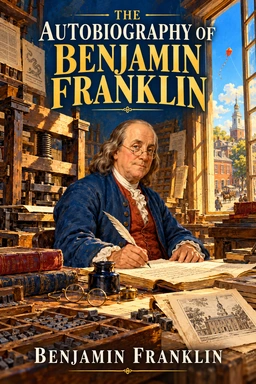
The Autobiography of Benjamin Franklin
Benjamin Franklin · c. 1771
Franklin's own story, from runaway apprentice to printer, scientist and statesman. The virtue plan is in chapter nine.
The 13 virtues, word for word
He picked thirteen virtues and wrote a short rule for each. Here they are as he gave them:
- Temperance. Eat not to dullness; drink not to elevation.
- Silence. Speak not but what may benefit others or yourself; avoid trifling conversation.
- Order. Let all your things have their places; let each part of your business have its time.
- Resolution. Resolve to perform what you ought; perform without fail what you resolve.
- Frugality. Make no expense but to do good to others or yourself; i.e., waste nothing.
- Industry. Lose no time; be always employed in something useful; cut off all unnecessary actions.
- Sincerity. Use no hurtful deceit; think innocently and justly; and, if you speak, speak accordingly.
- Justice. Wrong none by doing injuries, or omitting the benefits that are your duty.
- Moderation. Avoid extremes; forbear resenting injuries so much as you think they deserve.
- Cleanliness. Tolerate no uncleanliness in body, clothes, or habitation.
- Tranquillity. Be not disturbed at trifles, or at accidents common or unavoidable.
- Chastity. Franklin's own rule here is frank about sex, and many old school editions, including the one in our library, print the name and leave the rule out.
- Humility. Imitate Jesus and Socrates.
The order is deliberate. Temperance comes first because a clear head makes the rest easier. Silence comes next because, he said, he wanted to learn more by listening. Order frees time for study, Resolution keeps him at it, and so on down the list.
The chart: one virtue a week
This is the clever part. Franklin did not try to practise all thirteen at once:
I made a little book, in which I allotted a page for each of the virtues. I ruled each page with red ink, so as to have seven columns, one for each day of the week.
Across the columns ran thirteen lines, one per virtue. Each evening he put "a little black spot" against any virtue he had failed that day. But each week he concentrated on just one, leaving "the other virtues to their ordinary chance." If he could keep that line clean for a week, he added the next.
Proceeding thus to the last, I could go through a course complete in thirteen weeks, and four courses in a year.
He compares it to weeding a garden one bed at a time instead of attacking all the weeds at once. Thirteen weeks is a quarter of a year, so four rounds fit exactly into twelve months. If you want a New Year's system, this is one that has been tested for nearly three hundred years.
His daily schedule
To practise Order, Franklin also planned his day hour by hour. It begins and ends with a question:
- 5 to 7 a.m. "Rise, wash, and address Powerful Goodness! Contrive day's business, and take the resolution of the day: prosecute the present study, and breakfast." Morning question: "What good shall I do this day?"
- 8 to 11. Work.
- 12 to 1. "Read, or overlook my accounts, and dine."
- 2 to 5. Work.
- 6 to 9. "Put things in their places. Supper. Music or diversion, or conversation. Examination of the day." Evening question: "What good have I done today?"
- 10 to 4. Sleep.
What happened: Franklin's honest report card
The best thing about Franklin's account is that he admits it did not work perfectly:
I was surprised to find myself so much fuller of faults than I had imagined; but I had the satisfaction of seeing them diminish.
He scraped out so many marks that the paper wore into holes, so he moved his chart to ivory pages he could wipe clean. Order beat him completely. "In truth, I found myself incorrigible with respect to Order." And Humility, which he added only after a Quaker friend told him he was thought proud and "overbearing," he never really mastered: "I cannot boast of much success in acquiring the reality of this virtue, but I had a good deal with regard to the appearance of it."
His conclusion is the reason the plan is still worth trying:
But, on the whole, though I never arrived at the perfection I had been so ambitious of obtaining, but fell far short of it, yet I was, by the endeavour, a better and a happier man than I otherwise should have been if I had not attempted it.
He even tells the story of a man who asked a blacksmith to grind the whole surface of his axe bright, gave up halfway through the grinding, and decided that he liked "a speckled ax best." Franklin admits he was tempted by the same excuse.
How to use it in 2027
- Pick your own list. Franklin chose his thirteen; yours might be different, but keep each rule to one line.
- Focus on one per week and just keep track of the others.
- Mark only failures, not successes. The aim is a clean line.
- Run it four times a year. Expect Order to beat you, as it beat Franklin.
Questions people ask
- What are Benjamin Franklin's 13 virtues?
- Temperance, Silence, Order, Resolution, Frugality, Industry, Sincerity, Justice, Moderation, Cleanliness, Tranquillity, Chastity and Humility. Franklin gives each one a short rule in his Autobiography.
- How did Franklin track his virtues?
- In a small notebook with a page ruled in red ink into seven columns for the days of the week and thirteen rows for the virtues. Each evening he marked a black spot for each fault, concentrating on one virtue per week.
- Did Franklin succeed?
- Not completely, by his own account. He never mastered Order and said he got only the appearance of Humility, but he wrote that the effort made him "a better and a happier man" than he would otherwise have been.
- What was Benjamin Franklin's daily routine?
- He rose at five and asked "What good shall I do this day?", worked from eight to eleven and two to five, read and dined at noon, and ended with music or conversation and "What good have I done today?" before bed at ten.
- Where can I read Franklin's Autobiography for free?
- Here, in the Lost Library. The 13 virtues and the daily schedule are in chapter nine, "Plan for Attaining Moral Perfection."
Every book in this post
Free to read online, download, or send to your Kindle.

Keep reading
Classic literature
The Gift of the Magi: summary, meaning and the famous ending explained
O. Henry's Christmas story in a few minutes: Della's hair, Jim's watch, the twist, and what the last paragraph really means. Read the full story free.
Sacred texts
The real story of Hanukkah, from the Books of Maccabees
Why eight days? Is the miracle of the oil in the Bible? Who were the Maccabees? The story of Hanukkah as the ancient books tell it, with the verses that set the festival.
Classic literature
A Christmas Carol explained: the story, the three spirits and what Dickens meant
What A Christmas Carol is really about: Scrooge, Marley's chain, the three spirits, Ignorance and Want, and why Dickens wrote it in six weeks in 1843. With the best lines, word for word.