

Christopher Nolan's The Odyssey opened in July 2026 and became the biggest film of his career. It also did something rarer: it sent a huge number of people looking for the book. Then they hit the first question every Homer reader hits. There are dozens of English translations. Which one?
Here is a quick guide to the main ones, how they differ, and the two you can start reading right now for free.
Why the translations are so different
Homer composed in ancient Greek hexameter, a long, rolling six-beat line, for performance. No English version can keep everything: the meaning, the music, the speed and the strangeness. Every translator chooses. Some write rhyming verse, some blank verse, some plain prose. You can see it in the very first line, where Homer calls Odysseus polytropos, "of many turns." Each translator renders that word in a different way.
The free classics
William Cullen Bryant (1871) is the American poet's version in blank verse: unrhymed, dignified and very readable. It uses the Roman names (Ulysses, Minerva, Neptune), which can surprise readers who know the film.
Tell me, O Muse, of that sagacious man Who, having overthrown the sacred town Of Ilium, wandered far and visited The capitals of many nations
Best for: reading the whole poem as a poem, free, in a beautiful edition. This is the one we suggest most people start with.
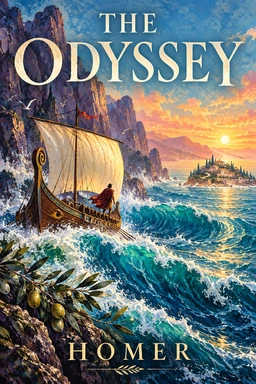
Homer · c. 800 BC
Bryant's blank-verse Odyssey, in a carefully proofread edition, with a free audiobook.
George Chapman (1614) is the Elizabethan version that made John Keats write "On First Looking into Chapman's Homer." It rhymes, it is wild and muscular, and it is hard going.
The man, O Muse, inform, that many a way Wound with his wisdom to his wished stay
Best for: lovers of Shakespeare-era English, and for the history of how Homer came into English.
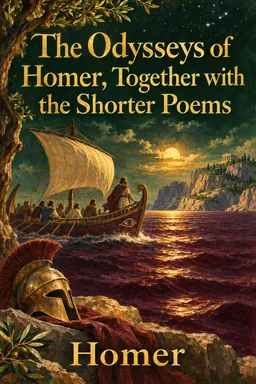
The Odysseys of Homer, Together with the Shorter Poems
Chapman's Odyssey, the translation Keats fell in love with, with a free audiobook.
The other old translations
These are also public domain:
- Alexander Pope (1725–26) turned Homer into rhyming couplets, with help from two collaborators. Elegant and very eighteenth century: "The man for wisdom's various arts renown'd."
- S. H. Butcher and Andrew Lang (1879) made a prose version in deliberately old-fashioned, Bible-like English. It was the standard school text for decades.
- Samuel Butler (1900), the author of Erewhon, made a brisk, plain prose version. It is the one to pick if you just want the story.
The modern translations
These are in copyright, but you will see them in every bookshop:
- Richmond Lattimore (1967): very close to the Greek, line by line. Accurate but stiff.
- Robert Fitzgerald (1961): a poet's version, graceful and long the classroom favorite.
- Robert Fagles (1996): big, dramatic and fast. "Sing to me of the man, Muse, the man of twists and turns." Probably the most popular today.
- Emily Wilson (2017): the first published English translation by a woman. It is famous for its plain, quick lines and its opening, "Tell me about a complicated man."
So which should you read?
- Want the story fast? Butler's prose, or Fagles.
- Want it to read like a poem, for free, today? Bryant.
- Want the most modern voice? Emily Wilson.
- Want the most faithful line-by-line version? Lattimore.
- Want to feel what Keats felt? Chapman.
And if you want a gentle way in, Stories from the Odyssey (1903) retells it in simple prose for young readers. It is a lovely read-aloud.


Questions people ask
- What is the best translation of The Odyssey?
- It depends what you want. Emily Wilson (2017) and Robert Fagles (1996) are the most popular modern versions. For a free one, William Cullen Bryant's blank-verse translation (1871) is very readable.
- Which Odyssey translation is closest to the Greek?
- Richmond Lattimore's (1967) follows the Greek most closely, line by line.
- Is The Odyssey free to read?
- Older translations are in the public domain. You can read Bryant's translation free here, and Chapman's too.
- Is Nolan's The Odyssey based on a particular translation?
- The film adapts Homer's poem itself. Any good translation will give you the same story, though they differ in tone and style.
Every book in this post
Free to read online, download, or send to your Kindle.


Keep reading
Sacred texts
The real story of Hanukkah, from the Books of Maccabees
Why eight days? Is the miracle of the oil in the Bible? Who were the Maccabees? The story of Hanukkah as the ancient books tell it, with the verses that set the festival.
Classic literature
A Christmas Carol explained: the story, the three spirits and what Dickens meant
What A Christmas Carol is really about: Scrooge, Marley's chain, the three spirits, Ignorance and Want, and why Dickens wrote it in six weeks in 1843. With the best lines, word for word.
Reading guides
EPUB vs PDF: which ebook format should you use?
EPUB or PDF? What each format is for, which one works on Kindle, Kobo, iPhone and Android, what happened to MOBI, and how to turn a PDF into an EPUB for free.