

In 1923 a Lebanese-American poet and painter living in New York published a slim book of prose poems. The Prophet got few reviews and sold slowly at first. Then it never stopped selling. A hundred years later it has been translated into more than a hundred languages, and its passages are read at a remarkable number of weddings, christenings and funerals.
The book has a simple frame. A prophet named Almustafa has waited twelve years in the city of Orphalese for a ship to carry him home. When it finally comes, the people gather and ask him to speak to them, one subject at a time, before he goes. Here is what he says, in Gibran's own words.
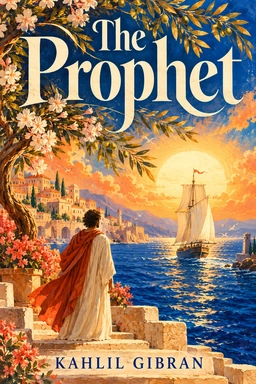
Kahlil Gibran · 1923
Gibran's 1923 masterpiece, free to read and with a free audiobook.
On love
Love gives naught but itself and takes naught but from itself. Love possesses not nor would it be possessed; For love is sufficient unto love.
When you love you should not say, "God is in my heart," but rather, "I am in the heart of God."
On marriage (the wedding reading)
This is the passage most people know, read at countless weddings:
But let there be spaces in your togetherness, And let the winds of the heavens dance between you. Love one another, but make not a bond of love: Let it rather be a moving sea between the shores of your souls.
It goes on: "Fill each other's cup but drink not from one cup," and ends with the image of a lute, whose strings "are alone though they quiver with the same music."
On children
Your children are not your children. They are the sons and daughters of Life's longing for itself. They come through you but not from you, And though they are with you yet they belong not to you.
You are the bows from which your children as living arrows are sent forth.
On giving
You give but little when you give of your possessions. It is when you give of yourself that you truly give.
On work
Work is love made visible.
Gibran follows it with an unforgettable image: "if you bake bread with indifference, you bake a bitter bread that feeds but half man's hunger."
On joy and sorrow
Your joy is your sorrow unmasked.
The deeper that sorrow carves into your being, the more joy you can contain.
"Is not the cup that holds your wine the very cup that was burned in the potter's oven?"
On pain, teaching and friendship
Your pain is the breaking of the shell that encloses your understanding.
No man can reveal to you aught but that which already lies half asleep in the dawning of your knowledge.
And let your best be for your friend.
On truth and beauty
Say not, "I have found the truth," but rather, "I have found a truth."
Beauty is eternity gazing at itself in a mirror.
On death
For life and death are one, even as the river and the sea are one.
For what is it to die but to stand naked in the wind and to melt into the sun?
And near the very beginning, as the ship arrives, comes the line many people quote at a farewell: "love knows not its own depth until the hour of separation."
More Gibran
The Prophet entered the US public domain in 2019, and several of Gibran's other books are free here too. Sand and Foam (1926) is a book of short sayings, including this one:
I have learned silence from the talkative, toleration from the intolerant, and kindness from the unkind; yet strange, I am ungrateful to these teachers.
- Sand and Foam

Sand and Foam
Cover of Sand and Foam - The Madman
- The Forerunner
- Jesus the Son of Man

Jesus the Son of Man
Cover of Jesus the Son of Man


If Gibran moves you, try the Persian mystic he is often compared to: see what Rumi really wrote.
Questions people ask
- What is the most famous quote from The Prophet?
- Probably "Your children are not your children. They are the sons and daughters of Life's longing for itself," from the chapter on children, or "Let there be spaces in your togetherness," from the chapter on marriage.
- What does Gibran say about marriage?
- "Let there be spaces in your togetherness, and let the winds of the heavens dance between you. Love one another, but make not a bond of love." Two people should be close but not merged, like the strings of a lute.
- When was The Prophet written?
- It was published in New York in 1923. Gibran had worked on it for years, and it became one of the best-selling books of the century.
- Is The Prophet free to read?
- Yes. It is in the US public domain and free to read here, with an audiobook.
Every book in this post
Free to read online, download, or send to your Kindle.
The Prophet
Kahlil Gibran · 1923
Sand and Foam
Cover of Sand and FoamSand and Foam
Kahlil Gibran · 1926
The Madman
Kahlil Gibran · 1918
The Forerunner
Kahlil Gibran · 1920
Jesus the Son of Man
Cover of Jesus the Son of ManJesus the Son of Man
Kahlil Gibran · 1928

Keep reading
Sufi poetry
Real Rumi quotes: what the poet actually wrote, from the old translations
Rumi is one of the most quoted poets on Instagram, and one of the most misquoted. Here are real lines from the Masnavi and the Divan of Shams, in the Victorian translations, and how to spot a fake.
Reading guides
EPUB vs PDF: which ebook format should you use?
EPUB or PDF? What each format is for, which one works on Kindle, Kobo, iPhone and Android, what happened to MOBI, and how to turn a PDF into an EPUB for free.
Reading guides
Why PDFs look terrible on a Kindle, and how to fix it for free
A PDF on a Kindle means tiny text, zooming and sideways scrolling. Here is why, and how to turn any PDF into a real ebook for Kindle, Kobo or Apple Books in a minute, free.