

Marcus Aurelius was the most powerful man in the world, emperor of Rome from 161 to 180 AD, and he spent his evenings writing notes to himself about how to stay calm, honest and kind. He never meant anyone to read them. We call them the Meditations, and nearly two thousand years later they are one of the most quoted books on the internet.
The trouble is that a lot of what gets quoted is not quite him. Some lines are loose modern paraphrases, some are other Stoics, and some are pure invention. So here are the real words, from George Long's classic 1862 translation, each with the book of the Meditations it comes from. Long writes "thou" and "thy," but the thoughts are startlingly modern.
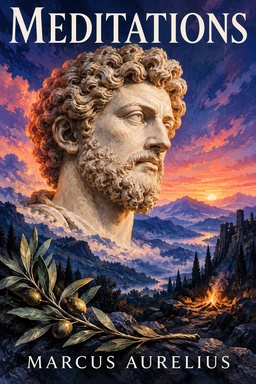
Marcus Aurelius · c. 170
The Meditations in George Long's translation, free to read and with a free audiobook.
On the mind and what disturbs it
If thou art pained by any external thing, it is not this thing that disturbs thee, but thy own judgement about it. And it is in thy power to wipe out this judgement now.
This is the core of Stoicism in one sentence, and the root of a lot of modern cognitive therapy: the event is not the problem, the story you tell about it is.
The universe is transformation: life is opinion.
Such as are thy habitual thoughts, such also will be the character of thy mind; for the soul is dyed by the thoughts.
On the obstacle
The phrase "the obstacle is the way" is the title of Ryan Holiday's 2014 bestseller, not a line from Marcus. But it is a fair summary of this passage:
For the mind converts and changes every hindrance to its activity into an aid; and so that which is a hindrance is made a furtherance to an act; and that which is an obstacle on the road helps us on this road.
On getting up and facing people
He opens Book II with a morning routine for dealing with difficult people, and it still works:
Begin the morning by saying to thyself, I shall meet with the busybody, the ungrateful, arrogant, deceitful, envious, unsocial.
He is not being bitter. He goes on to say that such people act out of ignorance, that they are his kin, and that "to act against one another then is contrary to nature." And when they do wrong him:
The best way of avenging thyself is not to become like the wrong doer.
On death and time
Marcus wrote much of the Meditations in army camps on the Danube frontier, with plague in the empire. Death is never far away in the book, and it makes him urgent rather than gloomy:
Do not act as if thou wert going to live ten thousand years. Death hangs over thee. While thou livest, while it is in thy power, be good.
Time is like a river made up of the events which happen, and a violent stream; for as soon as a thing has been seen, it is carried away, and another comes in its place, and this will be carried away too.
Every man lives only this present time, which is an indivisible point, and that all the rest of his life is either past or it is uncertain.
Loss is nothing else than change.
On fame and ego
Short-lived are both the praiser and the praised, and the rememberer and the remembered.
Everything is only for a day, both that which remembers and that which is remembered.
On living well
No longer talk at all about the kind of man that a good man ought to be, but be such.
Very little indeed is necessary for living a happy life.
Look within. Within is the fountain of good, and it will ever bubble up, if thou wilt ever dig.
The art of life is more like the wrestler's art than the dancer's.
The quiet place inside
Perhaps the most comforting passage in the book. People long for holidays in the country, by the sea or in the mountains, Marcus says, but you do not need to go anywhere:
It is in thy power whenever thou shalt choose to retire into thyself. For nowhere either with more quiet or more freedom from trouble does a man retire than into his own soul.
Where to go next
Marcus learned his Stoicism largely from Epictetus, a former slave, whom he quotes in the book. And the other great Roman Stoic, Seneca, wrote about anger, grief and the shortness of life in a way that pairs perfectly with the Meditations (we gathered his best lines).


Questions people ask
- What is the most famous Marcus Aurelius quote?
- Probably "If thou art pained by any external thing, it is not this thing that disturbs thee, but thy own judgement about it" (Meditations, Book VIII), often paraphrased as "you have power over your mind, not outside events."
- Did Marcus Aurelius say "the obstacle is the way"?
- Not in those words. The phrase is Ryan Holiday's. The original, in Book V, says "that which is an obstacle on the road helps us on this road."
- Which translation of the Meditations should I read?
- George Long's 1862 translation is the classic free version and the source of many famous quotes. Its "thou" and "thy" take a few pages to get used to. You can read it free here, with an audiobook.
- Was Marcus Aurelius a Stoic?
- Yes. He was the last great Stoic of the ancient world, and the Meditations are his private notes on practicing the philosophy while ruling an empire.
Every book in this post
Free to read online, download, or send to your Kindle.
Keep reading
Stoic wisdom
Seneca quotes on time, anger and death: what the Stoic actually wrote
"Life is long enough, if you know how to use it." Here are Seneca's best lines on wasted time, anger, grief and fortune, from the 1889 translation of his dialogues, with where each one comes from.
Reading guides
EPUB vs PDF: which ebook format should you use?
EPUB or PDF? What each format is for, which one works on Kindle, Kobo, iPhone and Android, what happened to MOBI, and how to turn a PDF into an EPUB for free.
Reading guides
Why PDFs look terrible on a Kindle, and how to fix it for free
A PDF on a Kindle means tiny text, zooming and sideways scrolling. Here is why, and how to turn any PDF into a real ebook for Kindle, Kobo or Apple Books in a minute, free.