

Every few months a picture goes around finance Twitter and TikTok: an old, hand-lettered chart with three rows of years, labeled Panics, Good Times, and Hard Times. It is usually titled "Periods When to Make Money," and it carries a confident instruction on the line for good times: high prices, and the time to sell.
On that row, between 2016 and 2034, sits 2026.
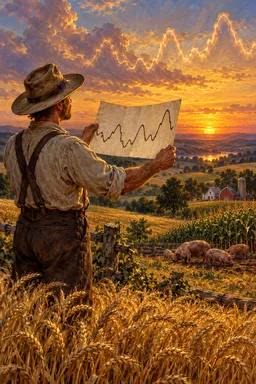
The chart is called the Benner cycle, after Samuel Benner, an Ohio farmer and ironmaster who lost everything in the Panic of 1873 and set out to find out whether prices move in cycles. His book is real, it is free, and almost nobody who shares the chart has read it.
Benner's Prophecies of Future Ups and Downs in Prices
Samuel Benner · 1884
Benner's own book, the 1884 edition, proofread here with its price tables and charts.
What the chart says
The version you have seen gives three lists of years:
- A. Panics: 1927, 1945, 1965, 1981, 1999, 2019, 2035, 2053.
- B. Good times, high prices, the time to sell: 1926, 1935, 1945, 1953, 1962, 1972, 1980, 1989, 1999, 2007, 2016, 2026, 2034, 2043, 2053.
- C. Hard times, low prices, the time to buy: 1924, 1931, 1942, 1951, 1958, 1969, 1978, 1985, 1996, 2005, 2012, 2023, 2032, 2039, 2050, 2059.
Fans point to the hits: 1929 is close to 1927, 1999 and the dot-com top, 2007 and the housing peak. Critics point out that a list this long will always land near something.
What Benner actually wrote
Here is the surprise: the famous chart is not in his book. It circulated separately, on cards and posters, built from his rules. The book itself is far stranger and more interesting. It is a farmer's notebook of prices, going back decades, for pig iron, hogs, corn, cotton and provisions, with Benner hunting for the rhythm under each one.
His master key was iron:
Pig-iron is our north star to guide us over the dangerous roads of commerce. It is the barometer of trade.
And his rule for panics was a repeating pattern of sixteen, eighteen and twenty years. He found it by counting the great American crises:
Commencing with the commercial revulsion of 1819, we find it was eighteen years to the crisis of 1837; twenty years to the crisis of 1857; and sixteen years to the crisis of 1873.
Then he did the bold thing. In print, in 1875, he predicted hard times in 1876 and 1877, a high in 1881, and the next great panic in 1891, one "which will not be confined to the United States, or this continent, but will sweep over the world."
How did he do?
Better than a farmer had any right to. The late 1870s were brutally hard. The early 1880s did boom. And the next great crash, the Panic of 1893, was one of the worst depressions in American history, with railroads and hundreds of banks failing on both sides of the Atlantic. Benner was two years early, but he called the shape of it eighteen years in advance.
What he could not do, and never claimed to, was predict the day. His cycles are about years, and about whole trades: when to build a furnace and when to bank it, when to raise hogs and when to stay out.
Should you trade on it?
No, and Benner would probably agree. His book is a warning against the people who expand at the top: the ironmaster who chopped a whole winter's wood in a boom year and was ruined by the next. It is an argument for patience, for cash in good times, and for courage in bad ones. That advice has aged better than any single date on the chart.
If you want more of the people who tried to read the market's rhythm, two later books are here too:

Thomas Gibson · 1907
Thomas Gibson's 1907 study of the swings in stocks, bonds, iron, wheat and cotton, with the signs of a coming crisis.

A 1927 novel by W. D. Gann, the legendary forecaster. Traders still read it looking for his hidden method.
Nothing here is financial advice. It is a 150-year-old conversation about why prices rise and fall, and a good one.
Questions people ask
- What is the Benner cycle?
- A theory of market cycles from Samuel Benner's 1875 book Benner's Prophecies of Future Ups and Downs in Prices: panics in a repeating 16, 18 and 20 year pattern, with years of good times and hard times between them.
- What does the Benner cycle say about 2026?
- The widely shared "Periods When to Make Money" chart lists 2026 as a year of good times and high prices, "the time to sell," with the next panic year at 2035.
- Did Samuel Benner predict the Panic of 1893?
- In 1875 he predicted a world-wide panic in 1891. The actual crash came in 1893, two years later than his date but in the shape he described.
- Where can I read Benner's Prophecies?
- Free, here, in a proofread edition with the original price tables.
Every book in this post
Free to read online, download, or send to your Kindle.


Keep reading
Prophecy
Nostradamus's 2026 predictions: what the quatrains actually say
A seven-month war, a swarm of bees, fire from the sky. Here are the verses behind the viral 2026 headlines, in the 1672 English translation, and what the old commentators thought they meant.
Sacred texts
The real story of Hanukkah, from the Books of Maccabees
Why eight days? Is the miracle of the oil in the Bible? Who were the Maccabees? The story of Hanukkah as the ancient books tell it, with the verses that set the festival.
Classic literature
A Christmas Carol explained: the story, the three spirits and what Dickens meant
What A Christmas Carol is really about: Scrooge, Marley's chain, the three spirits, Ignorance and Want, and why Dickens wrote it in six weeks in 1843. With the best lines, word for word.