

More than any other text, one poem invented the American Santa Claus. Before it, St. Nicholas came in many shapes, sometimes on foot, sometimes on a horse, sometimes as a stern bishop. After it, he was a "jolly old elf" with a tiny sleigh, eight reindeer and a sack of toys, coming down the chimney on Christmas Eve. It was first printed, without a name, in a small New York newspaper in December 1823. Here is what it really says.
The opening everyone knows
The edition in our library is a 1921 printing from the Atlantic Monthly Press, which follows the 1837 text, the first printing to name Clement Clarke Moore as the author. It opens:
'Twas the night before Christmas, when all through the house Not a creature was stirring, not even a mouse; The stockings were hung by the chimney with care, In hopes that St. Nicholas soon would be there;
Notice the title. The poem was never called "'Twas the Night Before Christmas." It was published as A Visit from St. Nicholas, and the visitor is St. Nicholas or St. Nick all the way through. The words "Santa Claus" never appear.
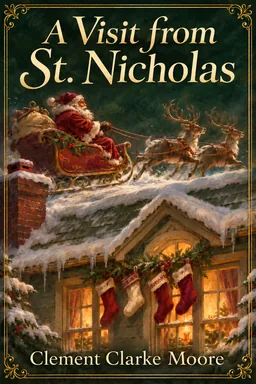
Clement Clarke Moore · 1823
The whole poem in a lovely 1921 edition with woodcuts by Florence Wyman Ivins. A five-minute read, perfect for reading aloud on Christmas Eve.
The reindeer names: Dunder and Blixem
The best-known lines name the team:
"Now, Dasher! now, Dancer! now, Prancer and Vixen! On, Comet! on, Cupid! on, Donder and Blixen!"
In the very first printing, in the Troy Sentinel of December 23, 1823, the last two were "Dunder and Blixem," from the Dutch words for thunder and lightning, a nod to old Dutch New York. The 1837 text in our edition has "Donder and Blixen," which rhymes better with Vixen. Moore's own 1844 collection of poems has "Donder and Blitzen," and that spelling stuck. "Donner," the version most people sing today, came in the twentieth century, helped along by the 1949 song about Rudolph.
And Rudolph? He is not in the poem at all. He was created in 1939 by Robert L. May for a booklet given away by the Montgomery Ward department stores. The original team is eight.
"Happy Christmas," not "Merry Christmas"
The ending is a small surprise for many readers:
But I heard him exclaim ere he drove out of sight— "Happy Christmas to all and to all a good night!"
Most modern picture books change it to "Merry Christmas." The original says "Happy," which is still the usual greeting in Britain.
The Santa it invented
Almost every detail of the modern Santa is here, set down for the first time in one place. He is small, an "elf," driving "a miniature sleigh and eight tiny rein-deer." He arrives on the roof and comes down the chimney. He is dressed "all in fur, from his head to his foot," with soot on his clothes. And then the famous portrait:
He had a broad face and a little round belly That shook when he laughed, like a bowl full of jelly. He was chubby and plump, a right jolly old elf, And I laughed when I saw him in spite of myself;
He also smokes a pipe, "the stump of a pipe he held tight in his teeth," a line that many modern editions now quietly leave out. The full-sized man in a red suit came later, mostly from Thomas Nast's cartoons in the 1860s and from advertising in the twentieth century.
If you want to know where St. Nicholas came from before this poem, our post on the pagan roots of Christmas follows him back to the bishop of Myra and his dark companion Krampus.
Who really wrote it?
The poem was printed anonymously in 1823, reportedly sent to the newspaper by a family friend. Clement Clarke Moore, a professor of Hebrew and Greek in New York, was named as the author in 1837 and included it in his own Poems in 1844. For most of two centuries, that settled it.
But the descendants of Henry Livingston Jr., a gentleman farmer and poet from the Hudson Valley who died in 1828, always said their ancestor wrote it and read it to his children years before 1823. In 2000 the literary detective Don Foster argued their case, pointing out that the poem's bouncy rhythm matches Livingston's other verse and that the Dutch names fit his family background. Other scholars, among them the historian Stephen Nissenbaum and later researchers, defended Moore. No manuscript in Livingston's hand has ever been found. The honest answer is that Moore has the stronger documentary claim and Livingston has a persistent family story, and the debate goes on.
Read it and pass it on
Reading this poem aloud on Christmas Eve is one of the oldest family traditions in America, and it takes about four minutes. Pair it with the other book that shaped the modern Christmas, Dickens's A Christmas Carol, which ends with Tiny Tim's "God Bless Us, Every One!"


Questions people ask
- What is the original title of 'Twas the Night Before Christmas?
- A Visit from St. Nicholas. It was first printed under that title, anonymously, in the Troy Sentinel in New York on December 23, 1823.
- Is it Donner or Donder?
- Neither was first. The 1823 printing had "Dunder and Blixem," Dutch for thunder and lightning. The 1837 text has "Donder and Blixen," Moore's 1844 book has "Donder and Blitzen," and "Donner" became common in the twentieth century.
- Does the poem end with Merry Christmas or Happy Christmas?
- The original ends: "Happy Christmas to all and to all a good night!" Many later editions changed it to "Merry Christmas."
- Is Rudolph one of the original reindeer?
- No. The poem names eight reindeer. Rudolph was created by Robert L. May in 1939 for a Montgomery Ward promotional booklet.
- Who wrote 'Twas the Night Before Christmas?
- It is traditionally credited to Clement Clarke Moore, who published it under his name in 1837 and 1844. Descendants of Henry Livingston Jr. claim he wrote it, and the question is still debated.
Every book in this post
Free to read online, download, or send to your Kindle.
Keep reading
Myth and folklore
The pagan roots of Christmas: Saturnalia, Yule, Krampus and the birthday of the Sun
Why December 25? Where do the Yule log, mistletoe and Krampus come from? The real answers from the old books: a Syrian Christian writer, Frazer's Golden Bough, and a 1916 history of St. Nicholas.
Classic literature
A Christmas Carol explained: the story, the three spirits and what Dickens meant
What A Christmas Carol is really about: Scrooge, Marley's chain, the three spirits, Ignorance and Want, and why Dickens wrote it in six weeks in 1843. With the best lines, word for word.
Reading guides
EPUB vs PDF: which ebook format should you use?
EPUB or PDF? What each format is for, which one works on Kindle, Kobo, iPhone and Android, what happened to MOBI, and how to turn a PDF into an EPUB for free.