
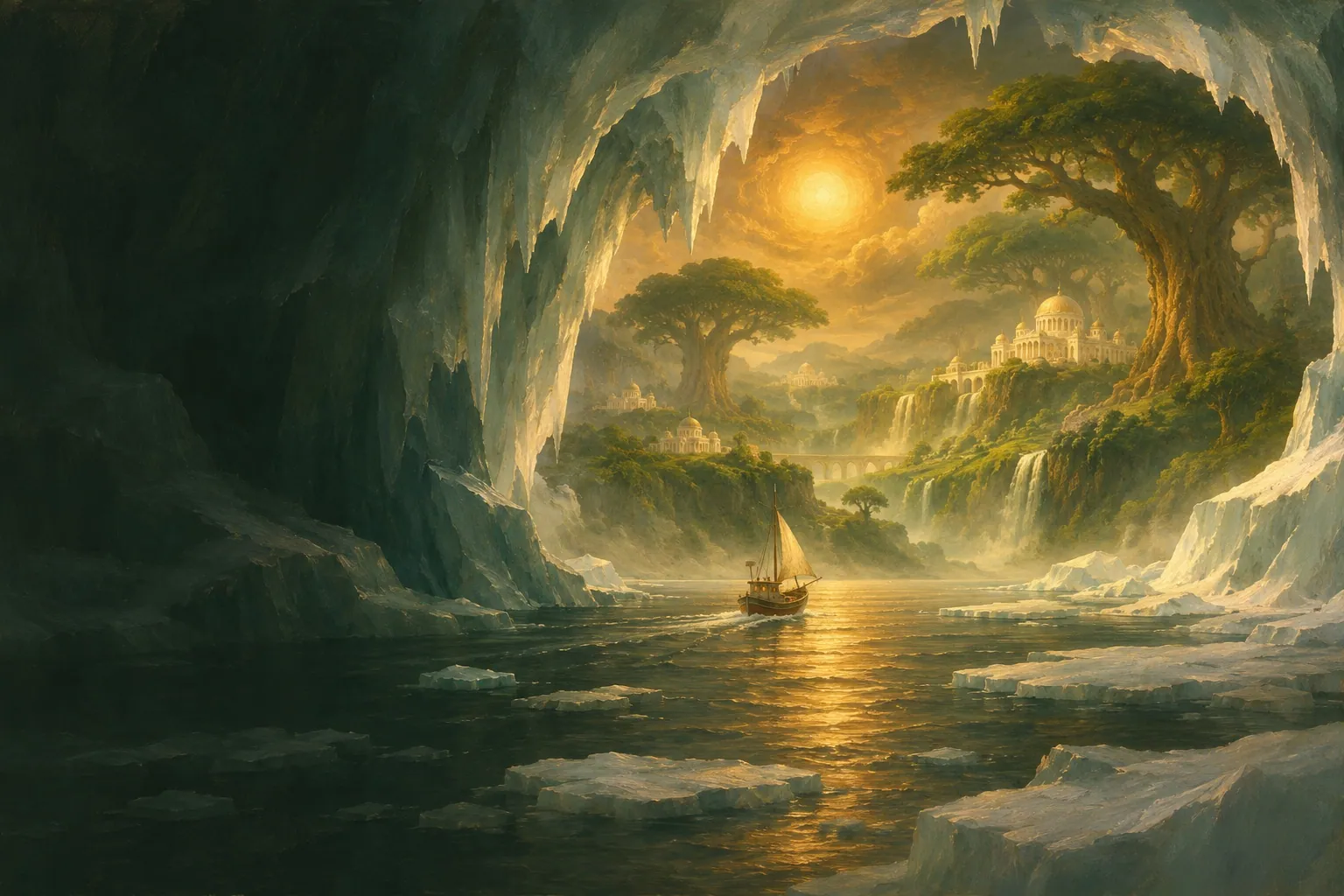
"Agartha" has become one of the internet's favorite jokes and one of its favorite rabbit holes at the same time: a hidden kingdom inside the earth, reached through openings at the poles, lit by an inner sun, home to a wiser and older race. Search it and you get memes, then documentaries, then a man very sure about Admiral Byrd.
Underneath all of it is a shelf of real books, most of them written between 1818 and 1908. They are stranger and better than the memes. Here they are, roughly in order.
1818: Captain Symmes's circular
The modern hollow earth begins with an American army officer, John Cleves Symmes Jr., who in 1818 mailed a circular to scientists, colleges and members of Congress declaring the earth "hollow, and habitable within," open at both poles, and asking for a hundred brave companions to sail north with him. He was widely mocked. He lectured for the rest of his life anyway, and his "Symmes holes" at the poles are still the entrances in every Agartha video.
1864: Journey to the Centre of the Earth
Jules Verne took the idea and made it adventure: a professor, his nephew and a guide climb down an Icelandic volcano and find an underground sea, giant mushrooms and prehistoric beasts.
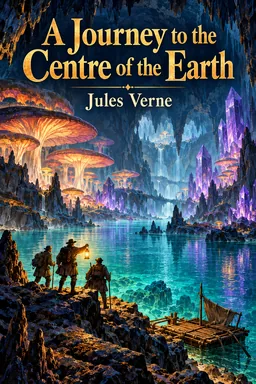
A Journey to the Centre of the Earth
Jules Verne · 1864
Verne's classic, still the most fun way into the inner earth.
1871: The Coming Race, and the power called Vril
Edward Bulwer-Lytton's novel imagines an underground race, the Vril-ya, who command a universal energy called Vril that can heal, destroy, or move matter. They are calm, beautiful and terrifying, and the narrator warns that they will one day come up and replace us. The book was so popular that a British meat extract was named Bovril after it. It also inspired a century of occult legends about secret "Vril" societies, most of them invented long after.
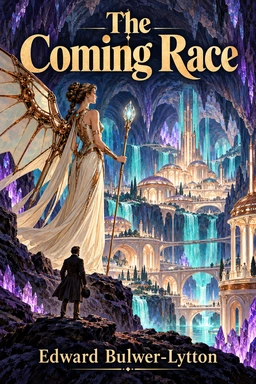
Edward Bulwer-Lytton · 1871
The novel that gave the world Vril, and a model for every advanced inner-earth race since.
1886: the name Agartha
The name itself comes from French occultists of the 1870s and 1880s, above all the Marquis Saint-Yves d'Alveydre, who described Agartha as a hidden underground center of the world's spiritual government, ruled by a sovereign pontiff, keeping the wisdom the surface world had lost. Later Theosophists and travelers wove it together with Tibetan legends of Shambhala.
1895: Etidorhpa
A Cincinnati pharmacist named John Uri Lloyd wrote one of the strangest books of the century. A white-bearded stranger forces a man to publish his manuscript, which tells how he was led by an eyeless guide down through the caves of Kentucky toward the hollow interior of the earth, into zones where weight itself begins to fade. The title is Aphrodite backwards.
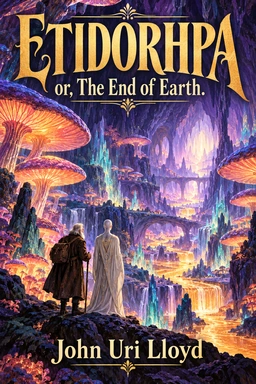
Etidorhpa; or, The End of Earth
John Uri Lloyd · 1895
A cult classic of mystical science fiction, written by a serious chemist.
1906: The Phantom of the Poles
William Reed set out to prove it scientifically. He collected the reports of Arctic explorers (warm winds from the north, open water beyond the ice, driftwood and dust where there should be none) and argued that no one had reached the pole because there was no pole to reach: only a great curving rim into the interior.
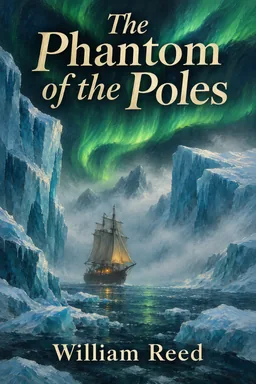
William Reed · 1906
The "evidence" book, full of real explorers' accounts read in a very unusual way.
1908: The Smoky God
This is the book most Agartha videos are secretly retelling. An old Norse sailor named Olaf Jansen, at ninety-five in a bungalow near Los Angeles, tells the author how as a boy he sailed with his father north past the ice and into the inside of the earth. They found a mighty river, vast forests, men who "would have measured fully twelve feet in height", and in the center a dim red sun:
It was "The Smoky God" of the "Inner World."
The giants worshiped it. Olaf's father died a terrible death on the way home, and when Olaf told the story, a relative had him committed to a madhouse for twenty-eight years. The author presents himself as a skeptic who could not shake it off, and loads the book with footnotes from polar explorers.
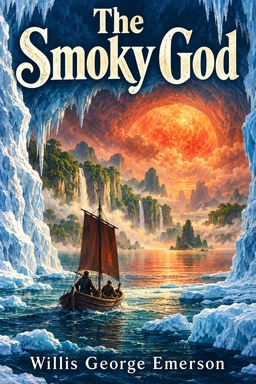
Willis George Emerson · 1908
The old sailor's tale behind the modern Agartha legend.
And Admiral Byrd?
Richard E. Byrd was a real American naval officer and explorer who flew over the poles and led expeditions to Antarctica in the 1920s through the 1950s. The famous "secret diary," in which he flies into a green land beyond the pole and meets a race of advanced beings, is a different matter: it appeared decades after his death and reads like a retelling of The Smoky God. Byrd's real books describe ice, cold, and a lot of hard work.
Why the hollow earth lasts
Every one of these books is about the same wish: that the world still has an unmapped place, and that someone, somewhere, kept the wisdom we lost. That is not a bad thing to want. Read them as what they are, the great lost-world literature of the nineteenth century, and they are a delight.


If you like this kind of thing, our post on what Plato really said about Atlantis goes the other direction: down, under the sea.
Questions people ask
- What is Agartha?
- A legendary kingdom inside a hollow earth, home to an ancient and wiser race. The name was popularized by the French occultist Saint-Yves d'Alveydre in the 1880s and later merged with hollow-earth stories and the Tibetan Shambhala.
- What book is the hollow earth theory from?
- The idea goes back to John Cleves Symmes in 1818, but the best-known source of the modern legend is The Smoky God (1908), the tale of a Norse sailor who found an inner sun and a race of giants.
- Did Admiral Byrd find the hollow earth?
- No. Byrd was a real polar explorer, but the "secret diary" describing a land inside the earth appeared long after his death and is not considered his work.
- What is Vril?
- A universal energy in Edward Bulwer-Lytton's 1871 novel The Coming Race, wielded by an underground people. The meat extract Bovril was named after it.
Every book in this post
Free to read online, download, or send to your Kindle.

Keep reading
Lost worlds
Atlantis: what Plato actually said, and the books that kept the search alive
Every Atlantis documentary goes back to two dialogues written 2,400 years ago. Here is the story as Plato told it, the line where it breaks off, and the Victorian books that turned it into a hunt.
Lost worlds
The Anunnaki: what the ancient tablets actually say (and what they don't)
Gold-mining aliens from the planet Nibiru? Here is what the Babylonian and Sumerian texts really say about the Anunnaki, the creation of humans from a god's blood, and Nibiru, in the old translations.
Before it was famous
The real books behind Dune: Lawrence of Arabia, Erewhon and the Butlerian Jihad
Before Dune: Part Three arrives, meet the old books Frank Herbert drew on: Lawrence's desert revolt, the 1872 novel where people smash their machines, and the Hebrew and Arabic words in Arrakis.