
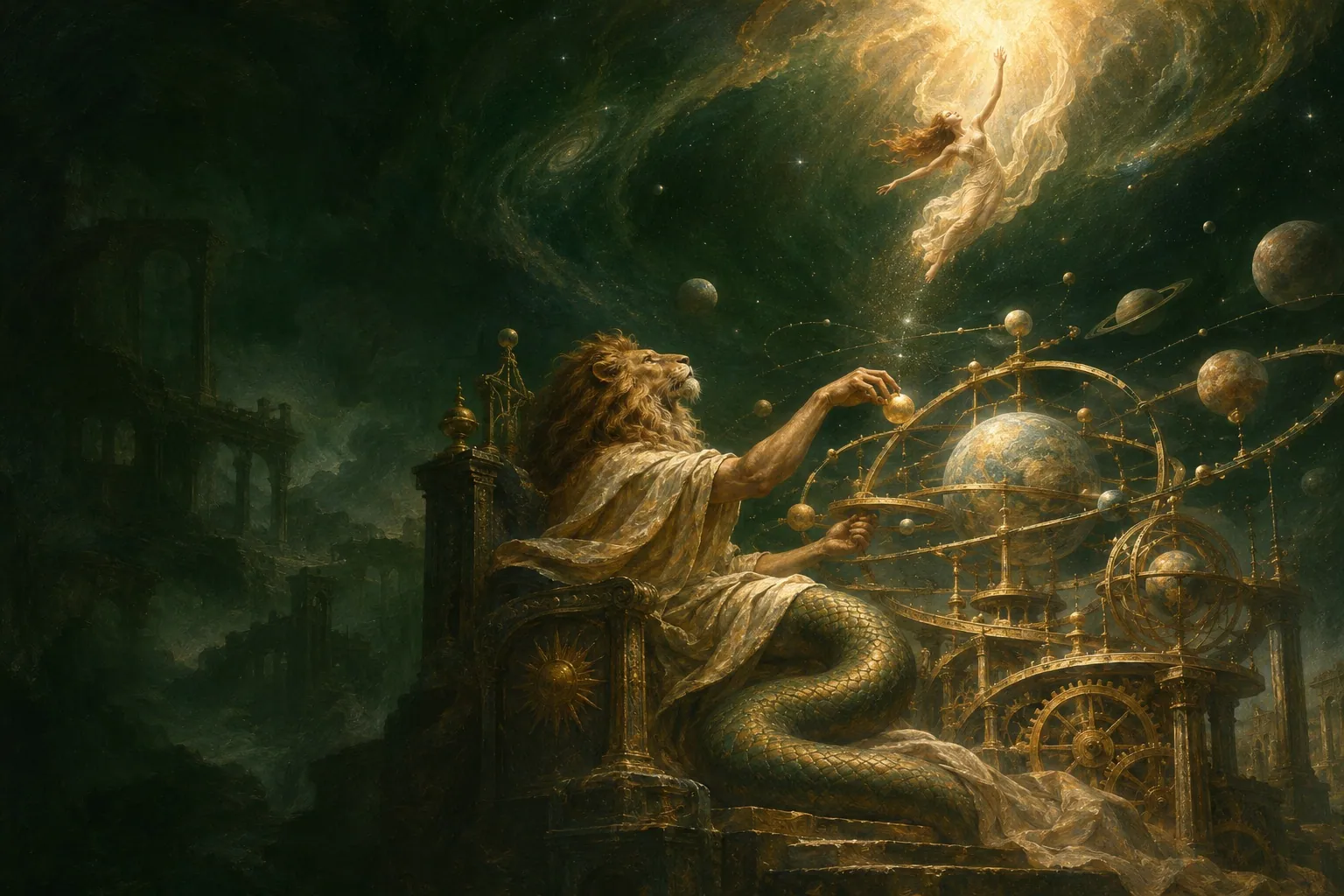
What if the world is a beautiful, elaborate prison, built by a lesser god who thinks he is the only one? What if a spark of the real God is trapped inside you, and the way out is not faith or good works, but knowing?
That is Gnosticism in a sentence, and after eighteen hundred years it is having a moment. Young people find it through The Matrix, through video games, through philosophy TikTok, and recognize something. Here is what the ancient Gnostics actually believed, in their own words where we have them, and the old books that preserved them.
What "gnosis" means
Gnosis is Greek for knowledge, but a particular kind: not facts, but direct, inner recognition of the divine. The Gnostics were not one church. They were dozens of teachers and schools in the second and third centuries, mostly Christian, some Jewish, some neither, with names like Valentinus, Basilides and Simon Magus. What united them was a story.
The Gnostic story
The true God is utterly beyond the world: unknowable, perfect, called the Unknown Father, the Depth, or the Boundless. From him come pairs of divine beings, the aeons, who together make up the Fullness, the Pleroma.
Sophia falls. The youngest aeon, Sophia (Wisdom), longs to know the Father directly, or to create on her own. Her desire goes wrong, and from it comes a malformed being outside the Pleroma.
The Demiurge makes the world. That being, often called Yaldabaoth, is the Demiurge, the craftsman. Ignorant of what is above him, he builds the material world and declares, "I am God, and there is no other." The Gnostics read the God of Genesis this way. A Victorian scholar of the Gnostics summed up their core belief:
The fundamental doctrine held in common by all the chiefs of the Gnosis was, that the whole creation was not the work of the Supreme Deity, but of the Demiurgus, a simple Emanation, and several degrees removed from the highest power.
The spark. But some of Sophia's light was caught in creation, and it lives in human beings. The rulers of this world, the archons, keep us asleep, distracted and forgetful.
The way out. A messenger of light comes from the true God (for Christian Gnostics, Christ) to wake us up and remind us who we are. Salvation is remembering.
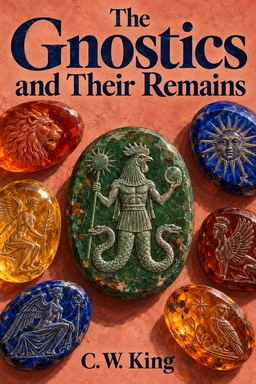
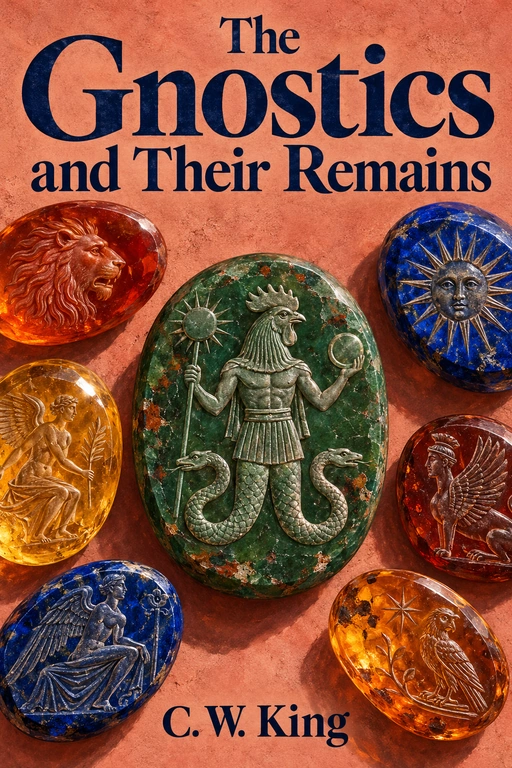
The Gnostics and Their Remains
C. W. King · 1887
C. W. King's classic study of the Gnostic schools, their gems and amulets, and the god Abraxas.
Pistis Sophia: a Gnostic gospel you can read
Most Gnostic writings were destroyed or lost. Until the great discovery at Nag Hammadi in Egypt in 1945, almost all we knew came from their enemies, the church fathers who wrote against them. One of the few complete Gnostic books known before then was a Coptic manuscript bought by an English doctor, Anthony Askew, and kept in the British Museum: the Pistis Sophia.
It opens after the resurrection. Jesus has spent eleven years teaching his disciples, and now reveals the highest mysteries. Mary Magdalene, John, Andrew and the others question him about the aeons, the treasury of light and the soul's ascent, and we hear the fallen Sophia herself, trapped in chaos, singing her songs of repentance:
This is the song which Pistis Sophia uttered in her first repentance, when she repented of her sin, reciting all things which had befallen her.
Mary Magdalene asks more questions than anyone else, and Jesus praises her for it. It is one of the strangest books to survive from the ancient world.
G. R. S. Mead · 1896
G. R. S. Mead's English translation of the whole codex.
Why it is back
Gnosticism speaks to a very modern feeling: that the world is somehow fake or rigged, that the people in charge don't know what they are doing, and that the real you is something the system can't see. The Matrix is a Gnostic story. So is The Truman Show. So, some argue, is every simulation theory.
The ancient Gnostics would add something the memes leave out. Their answer was not anger at the prison but an inward turn: self-knowledge, contemplation, and a kind of tenderness toward the trapped light in other people.
Where to go next
G. R. S. Mead spent his life gathering everything that survives. His books are still the best doors in:
Fragments of a Faith Forgotten
G. R. S. Mead · 1906
Mead's great survey of the Gnostic teachers and their fragments, before Nag Hammadi.
The magician of Acts, whom the church fathers called the first Gnostic.
Theodotus the Gnostic · 1886
Notes on the teaching of a Valentinian Gnostic, preserved by Clement of Alexandria.
- The Gnostic John the Baptizer
- The Gnostic Crucifixion
- Thrice-Greatest Hermes, Volume 1
- The Lost Books of the Bible


The Gnostics shared a world with the Hermetic writers: see the seven Hermetic principles. And if you want the gospels that the church kept out, see the books removed from the Bible.
Questions people ask
- What is Gnosticism in simple terms?
- An ancient religious movement which taught that the material world was made by a lesser, ignorant god (the Demiurge), that a spark of the true God is trapped in human beings, and that salvation comes through gnosis, direct knowledge of the divine.
- Who is the Demiurge?
- In Gnostic myth, the craftsman who made the material world, often named Yaldabaoth. He is ignorant of the true God above him and believes he is the only god.
- Who is Sophia in Gnosticism?
- Wisdom, the youngest of the divine aeons, whose fall produced the Demiurge. Her light became trapped in the world, and her repentance and rescue mirror the human soul's.
- Where can I read Gnostic texts free?
- Pistis Sophia, Fragments of a Faith Forgotten and The Gnostics and Their Remains are all free to read here.
Every book in this post
Free to read online, download, or send to your Kindle.
The Gnostics and Their Remains
C. W. King · 1887
Pistis Sophia
G. R. S. Mead · 1896
Fragments of a Faith Forgotten
G. R. S. Mead · 1906
Simon Magus
Excerpts of Theodotus
Theodotus the Gnostic · 1886
The Gnostic John the Baptizer
G. R. S. Mead · 1924
The Gnostic Crucifixion
Thrice-Greatest Hermes, Volume 1
G. R. S. Mead · 1906
The Lost Books of the Bible
William Hone · 1926


Keep reading
Lost books of the Bible
The books removed from the Bible, and where to read every one
The 1611 King James Bible had fourteen more books than yours. Here is what was taken out, why, and the lost gospels that never got in, all free to read.
Hermeticism
The seven Hermetic principles, explained in plain English
Mentalism, Correspondence, Vibration, Polarity, Rhythm, Cause and Effect, Gender: what each of the Kybalion's seven principles means, where they really come from, and what to read next.
Hidden wisdom
The Secret Teachings of All Ages is now free: a reader's guide to Manly P. Hall
A 27-year-old in Los Angeles wrote the century's great encyclopedia of hidden wisdom, and in 2024 it entered the public domain. What's inside, where to start, and the full book, free.