

In 1908 a small Chicago publisher put out a book with no author's name on the cover. It was signed only "Three Initiates," dedicated to Hermes Trismegistus, and it opened with a warning:
The lips of wisdom are closed, except to the ears of Understanding.
More than a century later The Kybalion is probably the most read occult book in the world. Its seven principles turn up on TikTok, in manifestation coaching, in tattoo parlors. Here is what each one actually says, in the book's own words, followed by the honest story of where they come from.
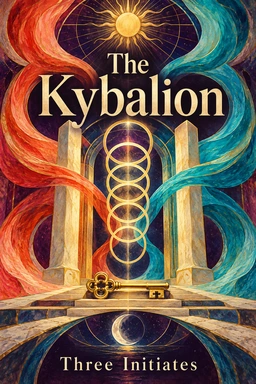
Three Initiates · 1908
The book itself. About three hours of reading, and the source of every quotation below.
1. The Principle of Mentalism
THE ALL is MIND; The Universe is Mental.
Everything that exists is a thought in an infinite mind, which the book calls THE ALL. Matter, energy and you yourself are mental creations. This is the foundation for everything else: if the universe is mental, then mind can act on it. The later chapters on "mental transmutation," changing your conditions by changing your mental states, all grow from this one line.
2. The Principle of Correspondence
As above, so below; as below, so above.
The laws that work on one plane of reality work on the others. What is true of the stars is true of the cell; what is true of the universe is true of the mind. The practical point: you can understand what you cannot see by studying what you can.
This is the oldest of the seven sayings. It comes, in slightly different words, from the Emerald Tablet, a short alchemical text attributed to Hermes that reached Europe through Arabic in the Middle Ages.
3. The Principle of Vibration
Nothing rests; everything moves; everything vibrates.
The difference between matter, energy, mind and spirit is only a difference in rates of vibration. Thoughts and feelings vibrate too, which is why the book claims you can change a mood by deliberately raising its "rate." Modern talk of "high vibration" and "low vibration" people starts here.
4. The Principle of Polarity
Everything is Dual; everything has poles; everything has its pair of opposites; like and unlike are the same; opposites are identical in nature, but different in degree; extremes meet; all truths are but half-truths; all paradoxes may be reconciled.
Hot and cold are the same thing, temperature, at different degrees. So are love and hate, courage and fear. Because they lie on one scale, the Kybalion says, you can slide a feeling toward its opposite instead of fighting it. This is the principle people find most useful in daily life.
5. The Principle of Rhythm
Everything flows, out and in; everything has its tides; all things rise and fall; the pendulum-swing manifests in everything; the measure of the swing to the right is the measure of the swing to the left; rhythm compensates.
Moods, markets, empires and seasons all swing. You cannot stop the pendulum, but the book teaches you to "neutralize" it: to notice the backward swing coming and refuse to ride it all the way down.
6. The Principle of Cause and Effect
Every Cause has its Effect; every Effect has its Cause; everything happens according to Law; Chance is but a name for Law not recognized; there are many planes of causation, but nothing escapes the Law.
Nothing is luck. Most people, the book says, are pushed around like pawns by causes they never see. The Hermetist learns to rise to a higher plane of causation and become a mover instead of one of the moved.
7. The Principle of Gender
Gender is in everything; everything has its Masculine and Feminine Principles; Gender manifests on all planes.
Not sex, the book insists, but generation: every act of creation needs a projecting, willing side and a receiving, forming side. In the mind these are the conscious "I" that wills and the "Me" that receives impressions and gives them shape. This is the least quoted principle and arguably the one the rest of the book relies on most.
Is The Kybalion really ancient?
Here is the part the TikTok videos leave out. The Kybalion presents itself as a compilation of secret teachings handed down from Egypt, but it was written in the early twentieth century, almost certainly by William Walker Atkinson, the most prolific author of the American New Thought movement, who ran the publishing house that issued it. The seven numbered principles appear nowhere in the ancient Hermetic writings.
That does not make it worthless. Atkinson was a gifted synthesizer, and the book is a brilliant, compact distillation of ideas that really are old: the mind-first universe of the Hermetic texts, the correspondence of the Emerald Tablet, the polarity of alchemy. But if you want the real ancient Hermes, you have to go to the source.
Where the real Hermes is
The genuine Hermetic writings are a set of Greek dialogues from Roman Egypt, written in the first centuries after Christ, in which Hermes Trismegistus ("thrice-great") teaches his son Tat and his student Asclepius about God, the mind and the soul's ascent. They were lost to the Latin West for a thousand years until a manuscript reached Florence in the 1460s and Marsilio Ficino translated it for Cosimo de' Medici, who told him to finish it before Plato.
The Divine Pymander of Hermes Mercurius Trismegistus
Hermes Trismegistus · 1884
The first English translation of the core Hermetic texts, from 1650. The translation the Kybalion's generation knew.
The Theological and Philosophical Works of Hermes Trismegistus
Hermes Trismegistus · 1882
The rest of the Corpus Hermeticum with the Asclepius, in plainer Victorian English.
Thrice-Greatest Hermes, Volume 1
G. R. S. Mead · 1906
G. R. S. Mead on who Hermes was, where the writings came from, and what Alexandria believed.
Read Poimandres, the first treatise, and you will hear the source of the Principle of Mentalism: a vision of a divine Mind that thinks the cosmos into being. Then the Kybalion makes much more sense, as a modern commentary on a very old idea.
Our reading path Hermeticism, from the first page takes you from the Kybalion through the ancient texts to the alchemists, in six books.
Questions people ask
- What are the 7 Hermetic principles?
- Mentalism (the All is Mind), Correspondence (as above, so below), Vibration, Polarity, Rhythm, Cause and Effect, and Gender. They come from The Kybalion, published in 1908.
- Who wrote The Kybalion?
- It is signed "Three Initiates." Most scholars attribute it to William Walker Atkinson, the New Thought writer whose Yogi Publication Society published it in Chicago.
- What does "as above, so below" mean?
- That the same laws work on every level of reality, so the small mirrors the great and the great mirrors the small. The phrase goes back to the Emerald Tablet of Hermes.
- Where can I read The Kybalion free?
- Right here, free to read online or download, with no account. It is in the public domain.
Every book in this post
Free to read online, download, or send to your Kindle.


Keep reading
Hermetic wisdom
The Emerald Tablet of Hermes: the real text behind "as above, so below"
The Emerald Tablets of Thoth on TikTok were written in the 1930s. The real Emerald Tablet is a short, strange alchemical text, over a thousand years older, and the source of "as above, so below."
Hidden wisdom
The Secret Teachings of All Ages is now free: a reader's guide to Manly P. Hall
A 27-year-old in Los Angeles wrote the century's great encyclopedia of hidden wisdom, and in 2024 it entered the public domain. What's inside, where to start, and the full book, free.
Hidden wisdom
Before angel numbers: what Pythagoras really taught about 1, 3, 7 and 10
Seeing 111 or 777 everywhere? Angel numbers are new, but the idea that numbers carry meaning is 2,500 years old. Here is what the Pythagoreans said about each number, from the old books.