
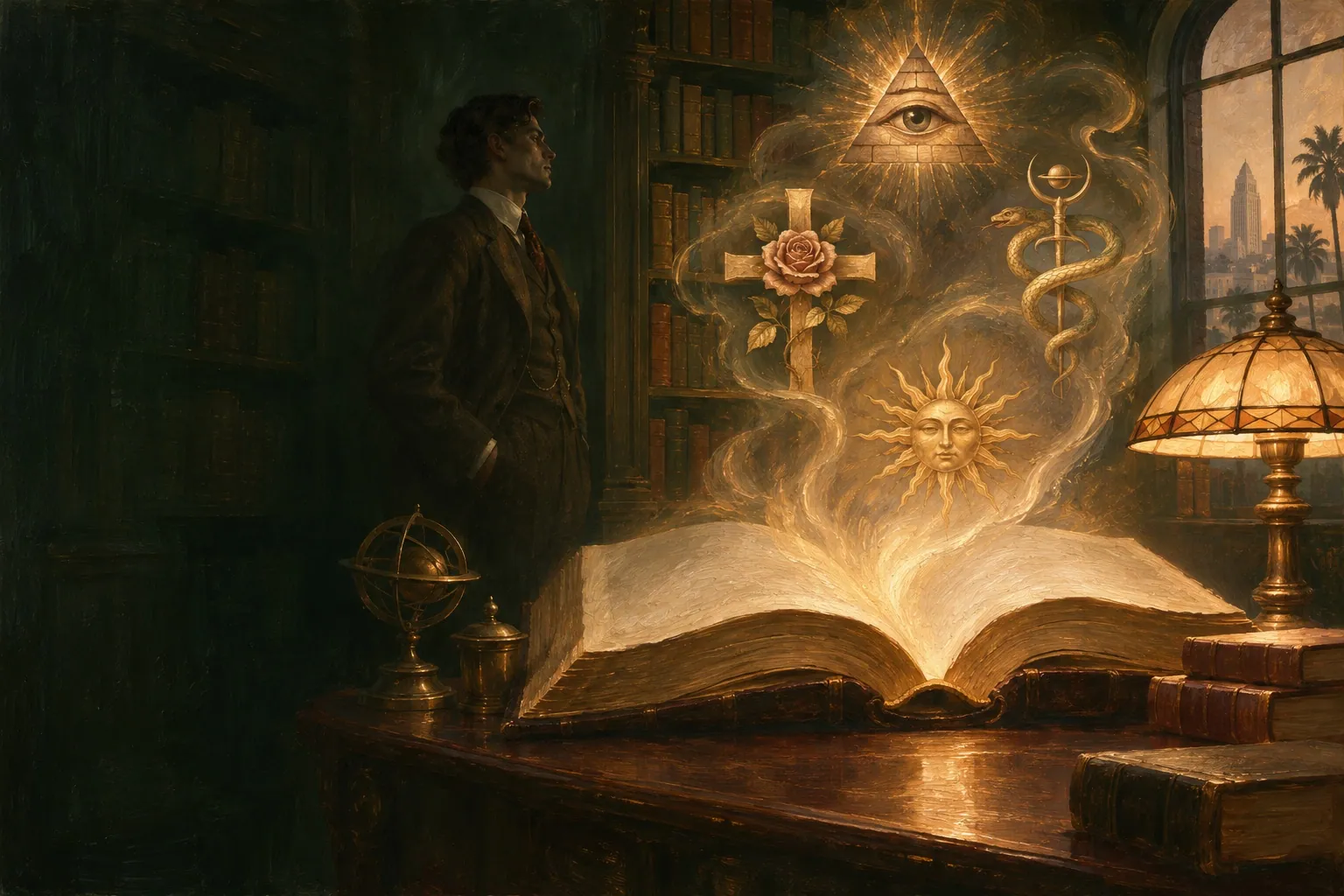
In 1928 a young man in Los Angeles published a book so large it needed a lectern. It was printed as a giant folio, with full-page color plates, and the first edition of 550 copies sold out to subscribers a full year before the manuscript was finished. Its author, Manly Palmer Hall, was twenty-seven.
The Secret Teachings of All Ages became the most famous occult book of the twentieth century: a single volume that tried to gather every esoteric tradition of the world, from the Egyptian mysteries to the Rosicrucians, from Pythagoras to the Tarot. For almost a century it was expensive and under copyright. On January 1, 2024, along with everything else published in the US in 1928, it entered the public domain.
The Secret Teachings of All Ages
Manly P. Hall · 1928
The whole encyclopedia, free to read online or download.
Who was Manly P. Hall?
Hall was born in Canada in 1901, raised largely by his grandmother, and arrived in Los Angeles as a teenager with no university education. He began lecturing on philosophy and religion in his early twenties and was soon drawing large crowds. He gathered rare books and manuscripts and wrote The Secret Teachings over about two years, with an artist, J. Augustus Knapp, painting the plates.
In 1934 he founded the Philosophical Research Society in Los Angeles, and he went on lecturing until his death in 1990, giving, by his own count, many thousands of talks. His preface strikes a humble note for so large a book:
I make no claim for either the infallibility or the originality of any statement herein contained.
What's inside
The book is a tour of what Hall called the "secret systems of philosophy" of the ancient world, and how they survived. The chapters include:
- The ancient Mysteries and secret societies: the Eleusinian and Mithraic rites, the Druids, the Gnostic mysteries.
- Atlantis and the gods of antiquity.
- Thoth Hermes Trismegistus, and the Hermetic writings.
- Pythagoras, his mathematics, and the Pythagorean theory of music and color.
- The Qabbalah, the Tree of Life, and the Tarot.
- Alchemy and the Hermetic marriage.
- The Rosicrucians, and the theory that Francis Bacon wrote Shakespeare.
- Freemasonic symbolism, the Hiramic legend, and ciphers.
- Mystic Christianity, Islam, and Native American symbolism.
It is not a book to read cover to cover. It is a book to open.
Where to start
If you have never read Hall, try these chapters first:
- The Life and Writings of Thoth Hermes Trismegistus. The clearest short introduction to Hermeticism you will find. Pair it with our guide to the seven Hermetic principles.
- The Life and Philosophy of Pythagoras. Hall at his best, telling a story.
- Atlantis and the Gods of Antiquity. Then read what Plato actually said.
- The Pythagorean Theory of Music and Color. The music of the spheres, explained.
- Bacon, Shakspeare, and the Rosicrucians. The secret-society chapter everyone argues about.
Is it accurate?
As history, not always. Hall drew on the scholarship of his day, much of which has moved on, and he often reports legends without saying so. As a map of what Western esoteric traditions believed, and how they saw themselves, it has never been bettered, and it is beautifully written. Read it as a guide to a world of ideas, then follow its trail to the sources. Most of them are here too.
Follow Hall's footnotes
Hall built his book on the classics of esoteric scholarship. These are some of his sources and companions, all free:
- The Kybalion
- The Divine Pymander of Hermes Mercurius Trismegistus
- The Holy Kabbalah
- The Pictorial Key to the Tarot
- The Real History of the Rosicrucians
- Mackey's Symbolism of Freemasonry
- The Gnostics and Their Remains
- Atlantis


And his own first book, on the ancient schools of initiation:
Hall's first book, written in his early twenties: the Mysteries, and the seekers who passed through them.
Questions people ask
- Is The Secret Teachings of All Ages in the public domain?
- Yes, in the United States. It was published in 1928, and US works from 1928 entered the public domain on January 1, 2024. It is free to read here.
- How old was Manly P. Hall when he wrote The Secret Teachings of All Ages?
- He began it in 1926 and published it in 1928, at the age of twenty-seven.
- What is The Secret Teachings of All Ages about?
- It is an encyclopedia of Western and world esoteric traditions: the ancient Mysteries, Hermeticism, Pythagoras, Kabbalah, alchemy, Tarot, Rosicrucianism, Freemasonry and mystic Christianity, with many illustrations.
- Where should I start with Manly P. Hall?
- Start with the chapters on Hermes Trismegistus and on Pythagoras in The Secret Teachings of All Ages, then explore the chapters that interest you. It is meant to be dipped into, not read straight through.
Every book in this post
Free to read online, download, or send to your Kindle.
The Secret Teachings of All Ages
Cover of The Secret Teachings of All AgesThe Secret Teachings of All Ages
Manly P. Hall · 1928
The Kybalion
Three Initiates · 1908
The Divine Pymander of Hermes Mercurius Trismegistus
Hermes Trismegistus · 1884
The Holy Kabbalah
Arthur Edward Waite · 1929
The Pictorial Key to the Tarot
Arthur Edward Waite · 1910
The Real History of the Rosicrucians
Arthur Edward Waite · 1887
Mackey's Symbolism of Freemasonry
Albert Gallatin Mackey · 1869
The Gnostics and Their Remains
C. W. King · 1887
Atlantis
The Initiates of the Flame

Keep reading
Hermetic wisdom
The Emerald Tablet of Hermes: the real text behind "as above, so below"
The Emerald Tablets of Thoth on TikTok were written in the 1930s. The real Emerald Tablet is a short, strange alchemical text, over a thousand years older, and the source of "as above, so below."
Hermeticism
The seven Hermetic principles, explained in plain English
Mentalism, Correspondence, Vibration, Polarity, Rhythm, Cause and Effect, Gender: what each of the Kybalion's seven principles means, where they really come from, and what to read next.
Hidden wisdom
Before angel numbers: what Pythagoras really taught about 1, 3, 7 and 10
Seeing 111 or 777 everywhere? Angel numbers are new, but the idea that numbers carry meaning is 2,500 years old. Here is what the Pythagoreans said about each number, from the old books.