
You look at the clock and it is 11:11. A receipt comes to $7.77. Your phone shows 3:33 three days in a row. On TikTok and Instagram, these are "angel numbers," messages from the universe, and there are thousands of videos on what each one means.
The phrase "angel numbers" is recent. It was popularized by the New Age author Doreen Virtue in the 2000s, and most modern "life path" numerology was worked out by American writers in the early twentieth century. But the belief underneath it, that numbers are not just quantities but powers with a meaning of their own, is very old. It goes back to Pythagoras, and the old books about him are stranger and richer than any angel-number chart.
Pythagoras: "the wisest thing is number"
Pythagoras lived in the sixth century BC, and he wrote nothing that survives. What we know comes from his followers, and from later writers like the philosopher Iamblichus, whose Life of Pythagoras was written around AD 300. Iamblichus records the short sayings that the Pythagoreans memorized, in question-and-answer form. One of them:
What is the wisest thing? Number.
For the Pythagoreans, numbers were the hidden structure of the world. They had found that musical harmony follows simple ratios, and they concluded that the cosmos does too. Iamblichus even credits the idea to the mythical poet Orpheus, who taught "that the eternal essence of number is the most providential principle of the universe, of heaven and earth, and the intermediate nature."
The Pythagoreans were also a secret brotherhood with strict rules, including a famous ban on eating beans. Iamblichus says Pythagoras once whispered into the ear of an ox until it gave up beans for good.
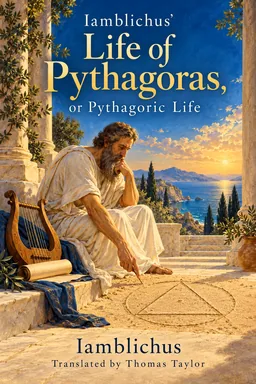
Iamblichus’ Life of Pythagoras, or Pythagoric Life
Iamblichus · 1818
The ancient biography of Pythagoras and his brotherhood, with the secret sayings, the bean rule and the number lore.
What each number meant
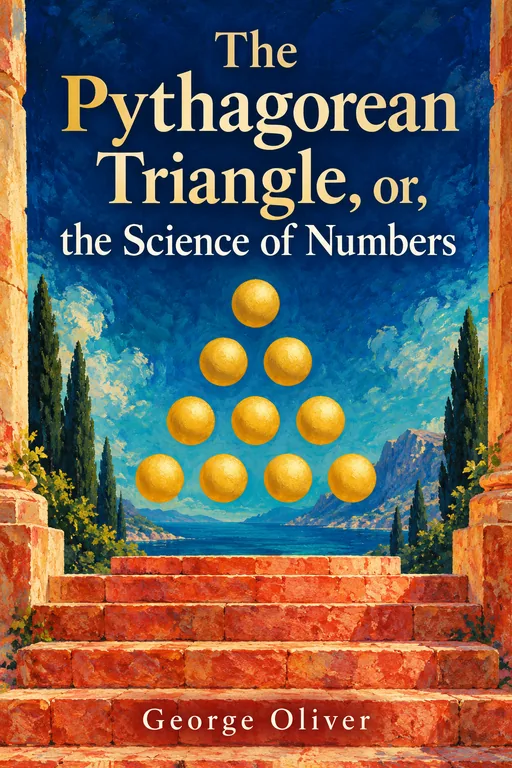
The fullest old guide to these meanings in English is The Pythagorean Triangle, or the Science of Numbers (1875), by George Oliver, an English clergyman and Freemason who gathered what the ancients said about each number.
One, the Monad. Not really a number at all, but the source of all of them. "The Pythagoreans say, 'The Monad is the principle of all things.'" It stood for mind, and for God.
Two, the Duad. The first division, and the first even number. "The monad was esteemed the father of Number, and the duad its mother: whence the universal prejudice in favour of odd numbers, the father being had in greater honour than the mother." Pythagoras taught that every person stands between virtue and vice, "like the lower part of the letter Y."
Three, the Triad. The first number with a beginning, middle and end:
The triad was esteemed the first perfect number, and hence oracles were delivered from a tripod.
Seven, the Heptad. The most mysterious of all. Among the numbers up to ten, it is the only one that is neither made by multiplying smaller numbers nor makes any other by being multiplied, so the Pythagoreans called it parentless:
The heptad was considered to be the number of a virgin, because it is unborn; without a father... or a mother... but proceeding directly from the monad, which is the origin and crown of all things.
Oliver notes that seven was sacred far beyond Greece. The Hebrews kept the seventh day holy, and Muslim tradition counts "seven climates, seven seas, seven heavens, and as many hells."
Ten, the Decad. The number that contains all the others. "The decad was the great number of the Pythagoreans, because it comprehends all arithmetical and harmonical proportions." It was called "Fulness and Eternity."
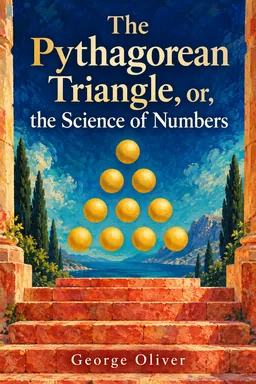
The Pythagorean Triangle, or, the Science of Numbers
George Oliver · 1875
George Oliver's 1875 guide to the meaning of every number from one to ten, and the Masonic lore built on them.
The Tetractys: the sacred triangle
The Pythagoreans' most sacred symbol was a triangle of ten dots in four rows: one, two, three, four. It was called the Tetractys, and it showed that the first four numbers add up to ten, the perfect number. They swore their oaths by it. Iamblichus gives the oath as:
Not by him who delivered to our soul the tetractys, which contains the fountain and root of everlasting nature.
The Golden Verses of Pythagoras, a short poem of moral advice once attributed to Pythagoras himself, ends with the same oath. In his famous 1813 commentary, the French mystic Fabre d'Olivet explains it as a vow "by the one who, teaching our soul to know itself, has put it in condition to know all nature of which it is the abridged image." The idea is the same one behind "as above, so below": the soul is a small copy of the universe.
666 and 13
Two numbers have a darker reputation. The first comes from the Bible:
Here is wisdom. Let him that hath understanding count the number of the beast: for it is the number of a man; and his number is Six hundred threescore and six.
Oliver notes that 666 "has engaged the attention of cabalistical theologians for 1800 years," and quotes the French Bible scholar Calmet, who listed fourteen different interpretations and gave up: "the wisest and safest way is to be silent." He also tells of a man who would bet two to one on 666, "because, says he, it is the number of the beast," since he believed bad men are the luckiest.
As for thirteen, Oliver records the Victorian superstition that thirteen at a dinner party means "one of the company is expected to die within the year," and dryly notes that "no such belief is attached to twelve or fourteen."
So what do angel numbers mean?
There is nothing in the ancient sources about seeing 111 on a clock. That is a modern practice. But if you are drawn to it, the old books give you something deeper than a list of meanings. To the Pythagoreans, noticing number was a spiritual discipline in itself: a way of seeing the order beneath a world that looks like chaos. Édouard Schuré, in Pythagoras and the Delphic Mysteries (1889), puts it this way:
In them Number was not regarded as an abstract quantity but as the intrinsic and active virtue of the supreme One, of God the source of universal harmony.
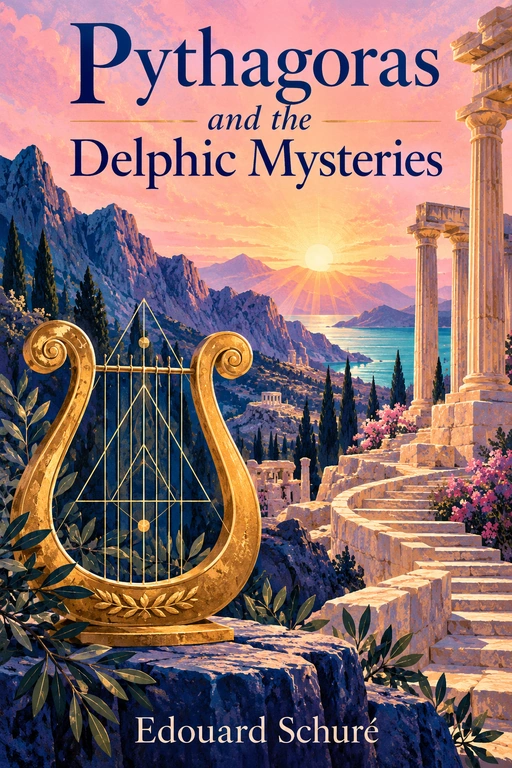
- Pythagoras and the Delphic Mysteries
- The Golden Verses of Pythagoras
- Theurgia, or, the Egyptian Mysteries
- The Kybalion


For the Hermetic idea of the soul as a small copy of the cosmos, see the Emerald Tablet and the seven Hermetic principles.
Questions people ask
- What are angel numbers?
- Repeating number sequences like 111, 333 or 777, which many people today read as messages from angels or the universe. The term was popularized in the 2000s. The older idea behind it, that numbers carry meaning, goes back to Pythagoras.
- What did Pythagoras believe about numbers?
- That number is the hidden structure of the cosmos. His followers' sayings include "What is the wisest thing? Number." Each number from one to ten had its own character, and ten, the sum of one to four, was perfect.
- What does the number 7 mean in numerology?
- The Pythagoreans called seven "the number of a virgin," because among the numbers up to ten it is neither produced by multiplying smaller numbers nor produces any. It was sacred in many traditions, including the seventh day of rest in the Bible.
- What is the Tetractys?
- A triangle of ten dots in rows of one, two, three and four, the most sacred symbol of the Pythagoreans. They swore oaths by it as "the fountain and root of everlasting nature."
Every book in this post
Free to read online, download, or send to your Kindle.
Iamblichus’ Life of Pythagoras, or Pythagoric Life
Iamblichus · 1818
The Pythagorean Triangle, or, the Science of Numbers
George Oliver · 1875
Pythagoras and the Delphic Mysteries
Edouard Schuré · 1909
The Golden Verses of Pythagoras
Antoine Fabre d'Olivet · 1917
Theurgia, or, the Egyptian Mysteries
Iamblichus · 1911
The Kybalion
Three Initiates · 1908


Keep reading
Hidden wisdom
The Secret Teachings of All Ages is now free: a reader's guide to Manly P. Hall
A 27-year-old in Los Angeles wrote the century's great encyclopedia of hidden wisdom, and in 2024 it entered the public domain. What's inside, where to start, and the full book, free.
Hermetic wisdom
The Emerald Tablet of Hermes: the real text behind "as above, so below"
The Emerald Tablets of Thoth on TikTok were written in the 1930s. The real Emerald Tablet is a short, strange alchemical text, over a thousand years older, and the source of "as above, so below."
Hermeticism
The seven Hermetic principles, explained in plain English
Mentalism, Correspondence, Vibration, Polarity, Rhythm, Cause and Effect, Gender: what each of the Kybalion's seven principles means, where they really come from, and what to read next.