
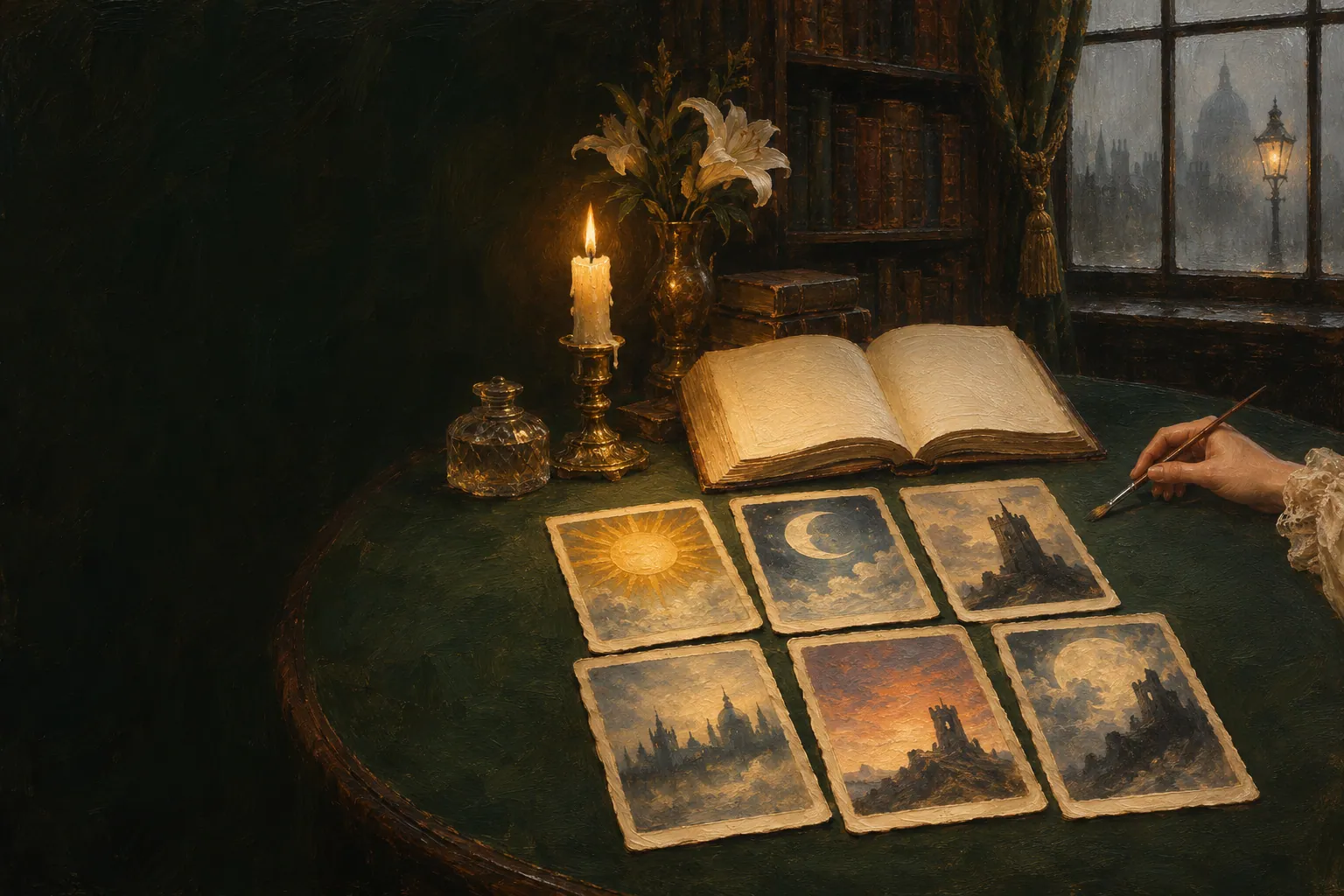
If you own a tarot deck, there is a good chance it is a copy of one drawn in 1909. The artist was Pamela Colman Smith, the publisher was William Rider and Son of London, and the designer was the occult scholar Arthur Edward Waite. The Rider-Waite deck (more fairly, the Waite-Smith deck) is the one nearly every modern deck descends from.
Waite also wrote the guidebook: The Pictorial Key to the Tarot. Every "card meaning" website on the internet is, in the end, quoting or paraphrasing it. Here are his meanings for all twenty-two Major Arcana, in his own words, and the strange confession he makes about them.
The Pictorial Key to the Tarot
Arthur Edward Waite · 1910
Waite's complete guide: the history of the cards, their symbolism, all 78 meanings, and the Celtic Cross spread.
The Major Arcana, in Waite's words
These are the "divinatory meanings" from Part III of the book, lightly trimmed. The words after Reversed are for a card that falls upside down.
- 0. The Fool. Folly, mania, extravagance, intoxication, delirium, frenzy. Reversed: negligence, absence, carelessness, apathy, vanity.
- 1. The Magician. Skill, diplomacy, address, subtlety; self-confidence, will. Reversed: physician, magus, mental disease, disgrace, disquiet.
- 2. The High Priestess. Secrets, mystery, the future as yet unrevealed; silence, tenacity; wisdom, science. Reversed: passion, conceit, surface knowledge.
- 3. The Empress. Fruitfulness, action, initiative, length of days. Reversed: light, truth, the unravelling of involved matters, public rejoicings.
- 4. The Emperor. Stability, power, protection, realization; a great person; authority and will. Reversed: benevolence, compassion, credit; immaturity.
- 5. The Hierophant. Marriage, alliance, captivity, servitude; mercy and goodness; inspiration. Reversed: society, concord, overkindness, weakness.
- 6. The Lovers. Attraction, love, beauty, trials overcome. Reversed: failure, foolish designs.
- 7. The Chariot. Succour, providence; also war, triumph, presumption, vengeance. Reversed: riot, quarrel, dispute, litigation, defeat.
- 8. Strength (Fortitude). Power, energy, action, courage, magnanimity; complete success and honours. Reversed: despotism, abuse of power, weakness, discord.
- 9. The Hermit. Prudence, circumspection; also and especially treason, dissimulation, roguery. Reversed: concealment, disguise, policy, fear.
- 10. Wheel of Fortune. Destiny, fortune, success, elevation, luck, felicity. Reversed: increase, abundance, superfluity.
- 11. Justice. Equity, rightness, probity; triumph of the deserving side in law. Reversed: legal complications, bigotry, bias, excessive severity.
- 12. The Hanged Man. Wisdom, circumspection, discernment, trials, sacrifice, intuition, divination, prophecy. Reversed: selfishness, the crowd, body politic.
- 13. Death. End, mortality, destruction, corruption. Reversed: inertia, sleep, lethargy, petrifaction; hope destroyed.
- 14. Temperance. Economy, moderation, frugality, management, accommodation. Reversed: things connected with churches and the priesthood; disunion, competing interests.
- 15. The Devil. Ravage, violence, vehemence, extraordinary efforts, force, fatality; that which is predestined but is not for this reason evil. Reversed: evil fatality, weakness, pettiness, blindness.
- 16. The Tower. Misery, distress, adversity, calamity, disgrace, deception. "It is a card in particular of unforeseen catastrophe." Reversed: the same in a lesser degree; oppression, imprisonment.
- 17. The Star. Loss, theft, privation, abandonment; another reading says hope and bright prospects. Reversed: arrogance, haughtiness, impotence.
- 18. The Moon. Hidden enemies, danger, darkness, terror, deception, occult forces, error. Reversed: instability, inconstancy, silence.
- 19. The Sun. Material happiness, fortunate marriage, contentment. Reversed: the same in a lesser sense.
- 20. The Last Judgment. Change of position, renewal, outcome. Reversed: weakness, simplicity; deliberation, decision, sentence.
- 21. The World. Assured success, recompense, voyage, route, emigration, change of place. Reversed: inertia, fixity, stagnation, permanence.
Some of these will surprise anyone who learned tarot from a modern book. Waite's Star begins with loss and theft. His Hermit means treason. His Fool is folly and frenzy, not the hopeful beginner of today's guides.
Wait, Death is not "transformation"?
In the fortune-telling section, no. Waite gives Death a blunt list: end, mortality, destruction. But in Part II, where he writes about the cards' deeper symbolism, he says the opposite of what the list suggests: the obvious meaning is death, "but the alternatives allocated to the symbol are change and transformation." Modern readers took the second reading and ran with it.
The same thing happens with the Fool. His divinatory meaning is folly. But his description of Pamela Colman Smith's picture is one of the most beautiful passages in the book:
With light step, as if earth and its trammels had little power to restrain him, a young man in gorgeous vestments pauses at the brink of a precipice among the great heights of the world.
Waite's confession
Here is the line that most tarot sites leave out. Right after listing the meanings above, Waite tells you what he thinks of them:
The allocation of a fortune-telling aspect to these cards is the story of a prolonged impertinence.
He calls the divinatory meanings "artificial and arbitrary" in the highest degree. For Waite, a member of the Hermetic Order of the Golden Dawn, the Major Arcana were not a way to tell the future but a sequence of mystical symbols, a picture book of the soul's journey. He included the meanings because his readers wanted them.
Go deeper
Papus · 1896
Papus's 1889 book, which ties the 22 trumps to the Hebrew alphabet and the Kabbalah. The French tradition Waite was answering.
A Manual of Cartomancy, Fortune-telling and Occult Divination
Arthur Edward Waite · 1909
Waite again, on reading ordinary playing cards, and other methods of divination.
If tarot is your door into the occult, the Hermeticism reading path is a natural next step, and our post on the seven Hermetic principles explains the ideas the Golden Dawn built on.
Questions people ask
- What is the original meaning of the Death tarot card?
- In Waite's 1910 Pictorial Key to the Tarot, the divinatory meaning is "end, mortality, destruction, corruption," while his symbolic reading allows "change and transformation." Reversed: inertia, sleep, lethargy.
- Who created the Rider-Waite tarot deck?
- Arthur Edward Waite designed it, Pamela Colman Smith drew it, and William Rider and Son published it in London in 1909. Waite's guidebook, The Pictorial Key to the Tarot, followed.
- Is The Pictorial Key to the Tarot free?
- Yes. It is in the public domain and free to read here, with every Major and Minor Arcana meaning.
Every book in this post
Free to read online, download, or send to your Kindle.


Keep reading
Hidden wisdom
The Secret Teachings of All Ages is now free: a reader's guide to Manly P. Hall
A 27-year-old in Los Angeles wrote the century's great encyclopedia of hidden wisdom, and in 2024 it entered the public domain. What's inside, where to start, and the full book, free.
Hermeticism
The seven Hermetic principles, explained in plain English
Mentalism, Correspondence, Vibration, Polarity, Rhythm, Cause and Effect, Gender: what each of the Kybalion's seven principles means, where they really come from, and what to read next.
Sacred texts
The real story of Hanukkah, from the Books of Maccabees
Why eight days? Is the miracle of the oil in the Bible? Who were the Maccabees? The story of Hanukkah as the ancient books tell it, with the verses that set the festival.